Law Firm Marketing
Law Firm Marketing Tactics (Part Three)
Updated: 02/17/2026

by Andrew Nasrinpay
Partner



Table of Contents
Strategy is theory. Plans are action. Most law firms completely fail to implement their sound strategies effectively. You can map audiences, journeys, value props, and competitors all day, but until you put numbers, timelines, and accountability behind it, it’s just a nice PowerPoint.
That’s where your marketing plan comes in. It’s the step-by-step blueprint for how your firm is actually going to win cases, build reputation, and grow.

Define the Goals of Your Marketing Campaigns
“Get more cases” isn’t a goal – not really. Real goals are specific, measurable, and tied to your bigger vision for the firm. Are you trying to increase overall case volume? Break into a new practice area? Expand into a new market? Each choice points you toward a different plan and a different budget.
The more precise you are, the better your plan will work.
For example:

Weak goals:
-
 “Grow our PI practice.”
 -
“Do more mass torts.”

Strong goals:
-
“Sign 300 new motor vehicle accident cases per month by Q3.”
-
“Increase Camp Lejeune leads by 20% in the next six months.”
Clear goals make tough choices easier. High volume vs. high value. Referrals vs. digital. Expansion vs. stability. When you know the destination, it’s much easier to pick the right route.
Exercise: Put Your Goal to the Test

If you can answer yes to all four, you’ve got a real goal.
Craft Your Marketing Message
Your message is the connective tissue between your value proposition and your marketing channels. It tells clients why they should call you, reminds referral partners why they should send you cases, and gives your staff a script they can actually use.
The biggest mistake firms make? Dilution. They try to be all things to all people, so their message ends up sounding like every other firm: “We care. We fight for you. We get results.” Those aren’t messages; they’re Muzak.
Instead, build one clear message and hammer it home across every channel. Billboards, intake scripts, social ads, TV spots: get consistent, and stick with your choices.
Jim Adler’s “Texas Hammer” tagline works because it’s consistent and unforgettable.
Morgan & Morgan’s “For The People” shows up everywhere, from billboards to staff shirts.
Consistency makes you recognizable, and that recognition can build trust.
Exercise:
Pressure-Test Your Message

If you can’t say “yes” to all three, refine it until you can.
Establish Your Marketing Budget
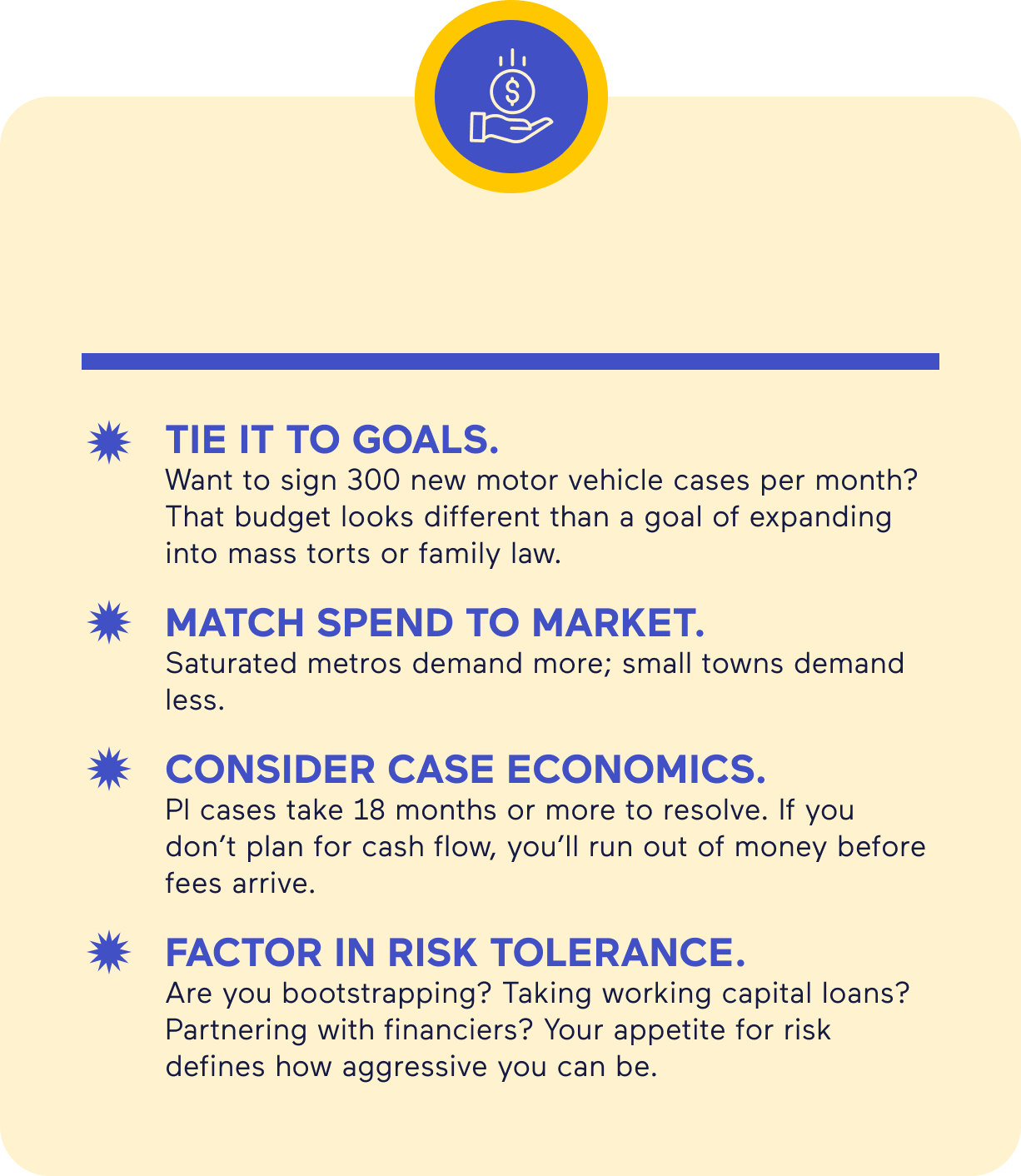
Your budget is where ideas turn into results. Every firm wants growth, but growth requires investment. Spend too little and you’ll disappear from the market. Spend too much without focus and you’ll waste great opportunities and see unit economics deteriorate.
In general, law firms should allocate 10–15% of gross revenue to marketing; consider that your baseline. The right number shifts based on your goals, case type, and geography. A personal injury firm in Houston fighting for billboards will need a bigger number than an immigration boutique in Des Moines.
The key isn’t asking, “What’s the minimum I can spend?” It’s asking, “What’s the right spend level to hit my goals?”
How to Think About Budget
Why Underinvesting Fails
Pulling back on spend might save money in the short term, but it outright kills a good strategy and plan. Certain marketing channels need significant investment in order to hit the proper economies of scale to negotiate good rates, and have enough reach and frequency to be effective. Otherwise, you risk losing out to your more consistent competitors.
Why Overspending Fails
Big checks don’t guarantee big results. Dumping money into TV, PPC, or SEO without tracking ROI is generally ill advised. The firms that win are the ones who know exactly where their dollars are working, and are willing to continue investing in successful campaigns and strategies, while also looking for additional opportunities.

Determine What Marketing Channels You Will Use
Every firm wants the “perfect” channel — the magic bullet that signs all the cases for good unit economics. Here’s the truth: you can’t dominate with one channel alone, and even if you did it would only be for a very short period of time.
Even with a massive spend in that one channel, you’ll still miss entire groups of clients: younger audiences who don’t watch traditional TV, digital-first clients who get information entirely through apps, older clients who only watch cable, or referrals who care more about your reputation than your ads.
That’s why most firms need a mix. No single channel covers all of that on its own, so most firms use a combination to reach their preferred clientele.
Part One: Choosing Channels
Think of channels as tools. You don’t need every tool for every job, but you do need the right ones to reach your goals and target market.
- Traditional media (Television, radio, billboards): Great for broad awareness, but expensive.
- Digital ads (PPC, Local Service Ads (LSAs), programmatic): Catch people at the moment they’re searching.
- SEO & content: Slow to see results, but powerful compounding growth over time with potentially the best unit economics of any channel.
- Social media: Good for engagement and staying top of mind, especially with younger demographics.
- PR & earned media: Builds credibility you can’t buy outright.
- Referrals & business development: Still the backbone of many firms.
Part Two: Media Mix Modeling
Media mix modeling is the practice of testing how your channels work together and shifting spend based on results. Instead of guessing, you use data to answer questions like:
- Which channel signs the most cases for the least cost?
- Which channel produces higher-value cases?
- Which channels overlap (e.g., clients who saw your TV ad and then clicked your PPC ad)?
- Where can you cut spend without losing momentum?
For example, if SEO is producing signed cases at $2,000 each and PPC is costing you $4,000 per case, you shift money into SEO. If billboards aren’t moving the needle in your city, but radio is driving calls, you reallocate. The mix changes as your market shifts, and smart firms adjust constantly.
Exercise:
Channel Mix Builder
If you can’t say “yes” to all three, refine it until you can.
Identify Your Ideal Client Type
The ideal client is different for everyone. The firms that grow consistently know exactly who their best clients are, and they build campaigns, intake systems, and even staffing decisions around those clients.
For injury firms, that might mean accident victims with clear liability, strong damages, and decent insurance. For family lawyers, it could be clients who can pay retainers and see their cases through. For mass tort shops, it’s qualified claimants in high-volume campaigns.
The point: your “ideal client” isn’t just a practice area. It’s a detailed profile with all the right criteria to result in higher fee income for your law firm.
What to Define
Your ideal client profile should cover four key areas:
- Case type: motor vehicle, med mal, mass tort, securities fraud.
- Demographics: age, income, education, geography.
- Psychographics: pain points, motivations, fears.
- Economics: ability to pay (for hourly firms) or insurance coverage/potential recovery (for contingency firms).
Ways to Use Personas in Practice
Earlier, we mapped out personas like Accident Andy, Divorce Darren, Corporate Carl, Mass Tort Maria, and Probation Pete. Personas like these keep your marketing sharp and targeted. Use them to:
- Test creative copy: Would Accident Andy actually click this ad? Would Divorce Darren trust this headline?
- Choose channels: Maria might Google late at night, Carl reads LinkedIn, Darren is scrolling Facebook.
- Train intake staff: Role-play calls so staff can practice reassuring Pete, calming Darren, or explaining fees to Andy.
- Plan content: Blog posts, videos, and FAQs should speak directly to a persona’s pain point, not to “everyone.”
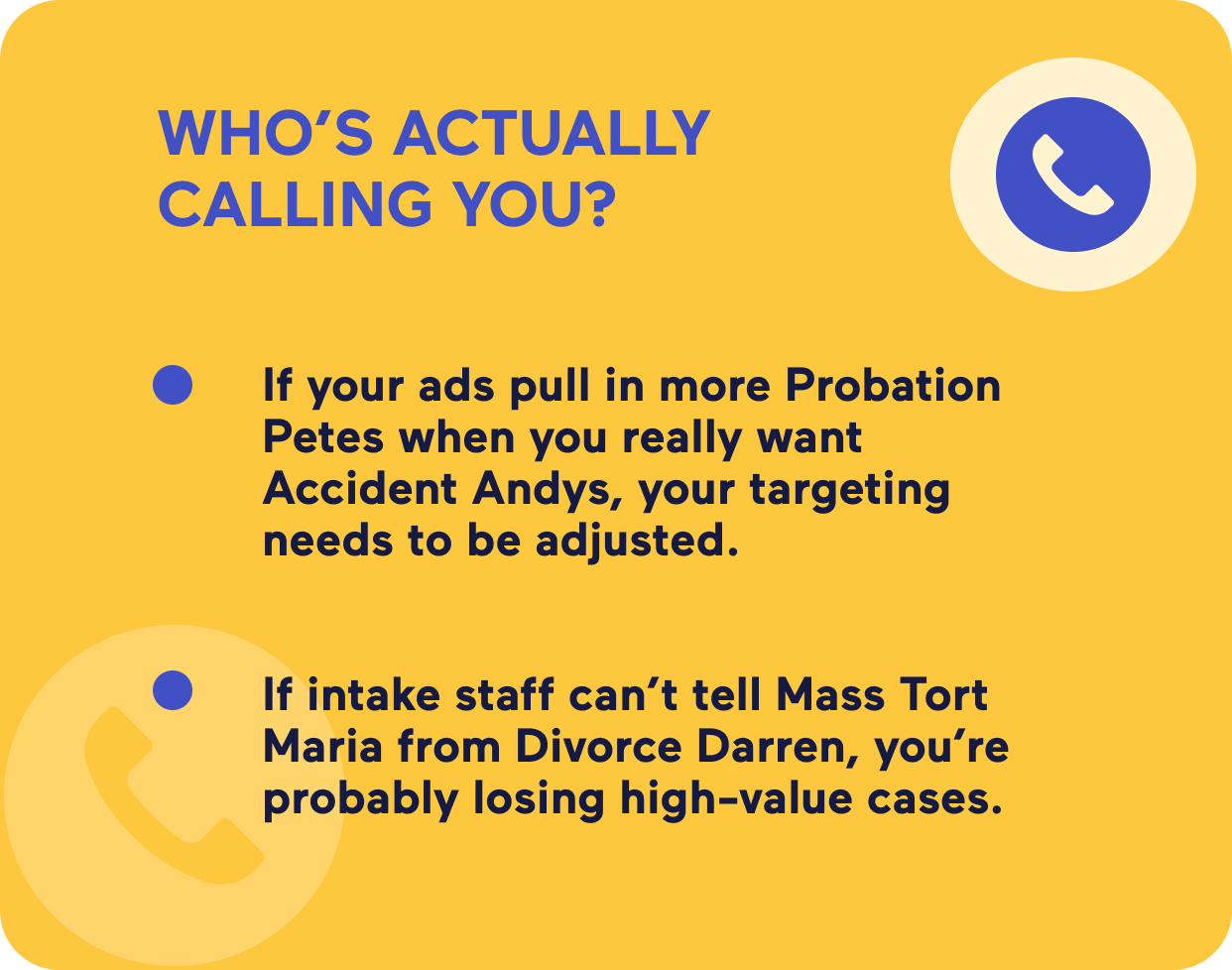
Remember, too, that your personas may need to change along with your practice. For example, if you’re trying to train an intake staff with Accident Andy and realize that every single staffer is making the same assumption about him, it’s up to you to determine:
A) Is that assumption fair?
B) Does your persona need to be adjusted?
C) How will this affect the way you’re marketing to targeted audiences?
Bottom line:
When you identify WHO you want to reach, your marketing gets more efficient: fewer wasted clicks, fewer unqualified leads. Your intakes will get smoother, and your overall results will get better. After all, you’ll be chasing cases you can actually win, not just calls you can answer.
Exercise:
Ideal Client Profile
If you can’t say “yes” to all three, refine it until you can.
Align Law Firm Operations with Marketing
Great marketing isn’t just about generating leads; it’s about making sure your firm is ready to capture, service, and maximize them. The more prepared you are, the more efficiently your marketing dollars turn into signed cases and satisfied clients.
Get Ready to Scale
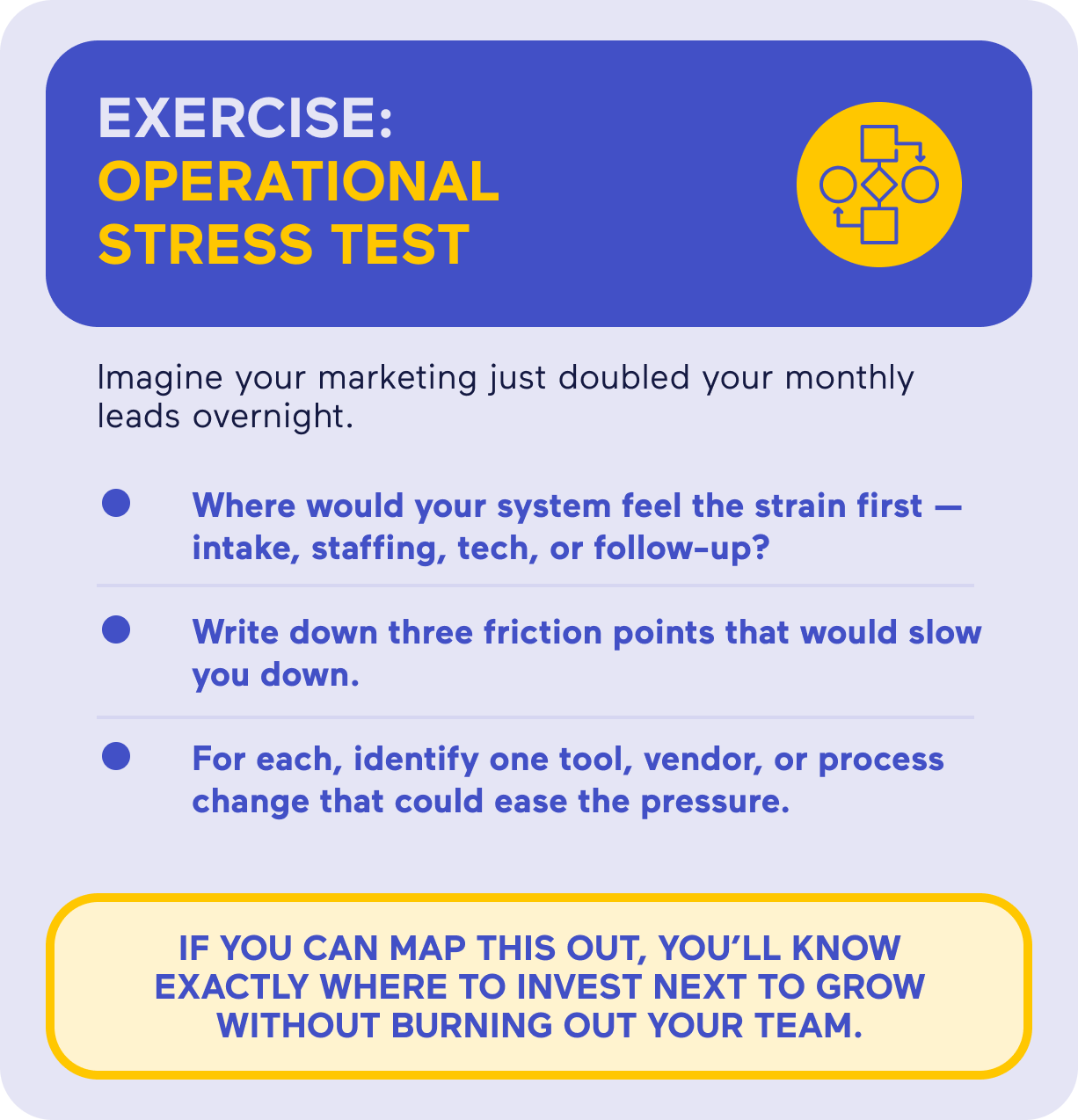
Before you flip the switch on bigger ad spend, take stock. Can your firm handle double the calls? Triple the intakes? More cases moving through the system? Scaling isn’t about bracing for disaster; it’s about building the foundation so growth feels manageable instead of overwhelming.
What to check before scaling:
✅ Intake bandwidth: Do you have enough staff (or overflow vendors) to answer calls quickly, day and night?
✅ Training: Has your intake team practiced scripts so they know how to handle high-value clients under pressure?
✅ Case capacity: Do your attorneys and case managers have room to handle more files, or will new cases sit idle?
✅ Technology: Are your CRM, call tracking, and practice management tools ready to handle the increase?
✅ Follow-up systems: Do you have automations in place (texts, emails) so leads don’t fall through the cracks?
Scaling is exciting! But it can also be unforgiving. The firms that grow smoothly aren’t necessarily the ones with the biggest budgets. They’re the ones that make sure operations can absorb the impact before turning up the volume.
Core Tools for Modern Law Firms
Successful firms usually have a common toolkit:
- Law firm management software: Keeps staff, cases, and deadlines aligned.
- Lead forms: Mobile-friendly and feeding directly into your CRM.
- Live chat: 24/7 intake for people who prefer typing over calling.
- Call tracking: See which campaigns actually generate leads.
- Website CMS: Easy-to-update platform for quick content and SEO fixes.
- Web accessibility tools: Make your site usable for everyone (and avoid ADA headaches).
- CRM and intake management: The backbone of lead tracking and follow-up.
- Telephony and call center tech: Reliable phone systems with capacity for overflow.
- Practice management: Case tracking, calendaring, and workflows in one place.
- Document management: Secure storage and searchability for staff and clients.
- Email and office suites: Cloud-based, scalable, and collaborative.
- Data visualization tools: Dashboards that show intake, caseload, and ROI at a glance.
Pro Tip:
There are a lot of platforms out there that offer many of these tools in one place, and can integrate the tools you need. Spend some time researching your options before choosing one, so that you can onboard them all at once.
Sample Software Stacks by Firm Type
Not every firm needs everything on day one. But every firm can match its tools to its stage:
Solo Practitioner
A phone, email, and maybe a free intake form. That’s enough to keep the lights on.
Small Firm
Cloud-based practice management, call tracking, a basic CRM, and a solid website CMS.
Mid-Size Firm
Full CRM + practice management integration, call center support, live chat, document management, and reporting dashboards.
Large Firm
The whole kit-n-caboodle, plus dedicated intake teams, vendor integrations, and often custom-built solutions.
Exercise:
Operational Stress Test
If you can’t say “yes” to all three, refine it until you can.
Finding and Fixing Bottlenecks
Every firm has friction points, right? So the question is whether you can spot and solve them.
The most common complaints we hear about are:
- Intake: Missed calls, slow responses, or staff who don’t close.
- Staffing: Not enough attorneys or case managers to handle the work.
- Processes: Manual data entry or disconnected systems.
- Technology gaps: No call tracking, no dashboards, no automation.
Common fixes include:
- Overflow vendors: Capture inbound and outbound calls when volume spikes.
- Automated follow-ups: Texts and emails triggered instantly so leads don’t go cold.
- Lead scoring rules: Prioritize high-value cases so staff spend time where it matters most.
- Integrated case/document management: Stop wasting time hunting for files.
- Centralized intake dashboards: Put all leads and calls in one place so nothing slips through.
- Call recording and QA: Review calls to improve scripts and staff performance.
- Scheduling tools: Let clients book consults online instead of endless phone tag.
- Cross-training staff: Prep paralegals or admins to back up intake during peak hours.
- Outsourced support: Tap external paralegals or attorneys for routine tasks to free internal staff.
- Automated document collection: Use tools that request IDs, insurance info, or police reports via text/email.
- Workflow automation: Trigger case creation, task assignments, and reminders automatically when a retainer is signed.
Make the Most of Positive Client Experiences
The best marketing doesn’t always come from ads, billboards, or SEO campaigns. It comes from clients who walked through your doors, had a good experience, and tell the world about it. Every happy client is a five-in-one marketing asset: reviewer, referrer, content source, repeat customer, and advocate. The more intentional you are about capturing and amplifying those experiences, the faster your marketing dollars multiply.
Capture Reviews and Testimonials
Don’t leave reviews to chance! Make them part of your process.
- Automate review requests the moment a case resolves.
- Collect video testimonials. (Even short clips make an impact on your website and social media.)
- Highlight written reviews on your website, social channels, and intake scripts.
- Turn strong reviews into spotlight graphics for ads and social proof.
- Build case studies (especially for B2B firms) that dig into measurable results.
Build a Referral Engine
Satisfied clients can become steady referral sources if you make it easy for them.
- Encourage word-of-mouth by reminding clients you welcome referrals.
- Track where referrals come from so you know which relationships are strongest.
- Maintain contact so you’re not forgotten the moment the case ends.
- Show appreciation: a thank-you note, a small gift, or even public recognition.
Use Real Stories, Not Hypotheticals
Client stories can fuel your marketing across platforms. Seek permission (or active participation) from former clients to highlight how you helped them:
- Share anonymized success stories in blogs and newsletters.
- Use short-form video to highlight “day in the life” wins.
- Pitch big wins to local media or industry publications.
- Celebrate milestones (like settlements or verdicts) on social channels.
- Humanize your firm with behind-the-scenes content tied to client outcomes.
- Create FAQ-style content from real client questions.
Reinforce Long-Term Relationships
Closing a case doesn’t mean closing the door. Past clients are one of your most valuable audiences, and staying in touch keeps your firm top of mind when they — or someone they know — need help again. That can be as simple as sending a quarterly newsletter with resources and updates, marking case anniversaries with a check-in, or inviting former clients to community events. Seasonal touchpoints like holiday cards or back-to-school safety reminders also go a long way. And don’t forget cross-practice opportunities: a personal injury client today might be a family law or employment law client tomorrow, and they may turn to you for help. Consistent, thoughtful contact turns a one-time client into a lifelong relationship.
Exercise:
Client Experience Plan
If you can’t say “yes” to all three, refine it until you can.

our authors





Sources and References
Reno, J. (2023, November 20). #1970s #muzak enjoy the #relaxing sounds of department store music from the 70s [Video]. YouTube. https://www.youtube.com/watch?v=D_sQFIVw6G0
Essential Law Firm Marketing Terms

A/B Testing: Running two versions of an ad, email, or page to see which performs better.
Attribution: Understanding which channel or campaign actually drove a signed client.
Bounce Rate: The percentage of visitors who leave your site without clicking further.
Brand Differentiation: How you make your firm stand out from competitors in tone, style, and message.
Call-to-Action (CTA): A clear prompt (button, link, phrase) that directs users to take the next step, such as contacting the firm or booking a consultation.
Call Tracking: Technology that shows which ads, campaigns, or numbers drove calls to your firm.
Click-Through Rate (CTR): The percentage of people who click on your ad or link after seeing it.
Content Marketing: Using articles, videos, guides, and FAQs to attract and educate potential clients.
Conversion: When a lead takes the desired action (calls, fills out a form, books a consult).
Conversion Rate: The percentage of people who visit a page or see an ad who then take a desired action (call, form fill, etc.).
Cost Per Acquisition (CPA): How much it costs you to land a signed client from marketing spend.
Customer Relationship Management (CRM): Software that tracks leads, follow-ups, and client communications.
Earned Media: Press coverage or mentions you didn’t pay for — news stories, interviews, features.
E-E-A-T: Google’s framework for ranking sites: Experience, Expertise, Authority, and Trustworthiness.
Geotargeting: Delivering ads to people in a specific geographic area.
Impressions: The number of times your ad or content is displayed (whether or not someone clicks).
Intake: The process of handling incoming leads, from first contact through signed retainer.
Key Performance Indicator (KPI): Metrics that measure success, like signed cases, cost per lead, or intake response time.
Keywords: Words or phrases that describe the topics your content and ads are built around. They signal to search engines what your page is about.
Landing Page: A standalone web page designed to capture leads for a specific campaign.
Lead Scoring: Ranking leads based on likelihood to convert so intake prioritizes the best cases.
Lifetime Value (LTV): The total revenue one client brings to your firm over the relationship.
Local SEO: Optimizing for local searches (“divorce lawyer near me”), Google Business Profiles, and directory listings.
Local Service Ads (LSAs): Pay-per-lead ads at the very top of search results with the green “Google Screened” badge.
Media Mix Modeling (MMM): A fancy term for a regression model that tests and analyzes the effectiveness of different spend percentages in different channels (TV, PPC, SEO, billboards) to see which combination produces the best results.
Organic Search: Website traffic that comes from unpaid search engine results.
Out-of-Home Advertising (OOH): Marketing outside the home, like billboards, buses, or transit ads.
Owned Media: Content you control directly — your website, blogs, email list.
Paid Media: Ads you pay for — PPC, social ads, TV spots, billboards.
Pay-Per-Click (PPC): Ads where you pay each time someone clicks (e.g., Google Ads).
Retargeting: Ads served to people who’ve already visited your site, reminding them to come back.
Search Engine Optimization (SEO): The process of improving your website so it shows up higher in Google search results. Includes technical fixes, content creation, and backlink building.