Law Firm Marketing
Law Firm Marketing Strategy (Part Two)
Updated: 02/17/2026

by Andrew Nasrinpay
Partner



Table of Contents
Who Do You Think You Are?
Success doesn’t look the same for all types of law firms, right? What matters is not who you are: it’s whether your marketing reflects that identity. Too many firms try to market like their competitors instead of leaning into their own strengths, and that’s the fastest way to blend into the noise.

Volume Firms (aka marketing law firms or referral firms)
Marketing is your lifeblood. You need constant intake, broad targeting, and media spend that never stops. Consistency beats creativity, though the best do both.
Ex. Sokolove Law Firm, Top Dog Law, asbestos.com & drugwatch.com (The Peterson Law Firm)
Vertically Integrated Firms
You need marketing that emphasizes full control: “We don’t just sign cases, we litigate them.” Messaging should highlight your ability to handle cases from intake through trial.
Ex. Morgan & Morgan, Lerner & Rowe, Jacoby & Meyers, Sweet James
Trial Firms
Your brand equity lives in your track record. Referrals and reputation are everything. Marketing here is about credibility, verdicts, and peer recognition, not leads at scale.
Ex. Panish Shea and Ravipudi, Power Rogers, Mark Lanier, etc.
Full-Service Firms
Your challenge is coherence. You serve different audiences, so you need brand messaging that ties it all together without looking watered down.
Ex. Porter Simon, Bailey Glasser, Stark & Stark
Specialist (“Boutique) Firms
Niche is your superpower. Marketing should be hyper-focused, with content, SEO, and ads tailored to your one audience.
Note: Boutique firms win by doing one thing exceptionally well. That focus lets them run leaner, build deeper referral pipelines, and capture better margins than generalists. Volume may be limited at first, but the most successful boutiques often grow into full-scale, vertically integrated firms over time.
General Practice Firms and Solo Practitioners

Survival mode requires flexibility. Marketing has to make you visible in your market without burning through a limited budget.
Ex. Altamirano PLLC, Jeff Murphy Law
Big Law and Insurance Defense Firms (aka transactional law firms, white shoe law firms, AM Law 200, etc)
Your marketing game is B2B. Reputation, thought leadership, and rainmaking drive growth more than mass advertising.
Ex. Jones Day, Abrams Fensterman
The point isn’t to label yourself. It’s to make sure your marketing spend and strategy line up with who you actually are. Firms that get this wrong waste thousands chasing cases they’ll never land, while firms that get it right look like they’re everywhere their clients already are.
What Types of Cases Are You Competing For?
Every law firm is chasing clients, but not all case types carry the same level of competition. Some markets are fragmented and easy to break into; others are flooded with firms pouring millions into ads. If you don’t understand where your practice area sits on that spectrum, you risk overspending in the wrong places — or missing opportunities in the right ones.

Exercise:
Marketing Management Gap Analysis
What Does the Market Look Like for Lawyers?
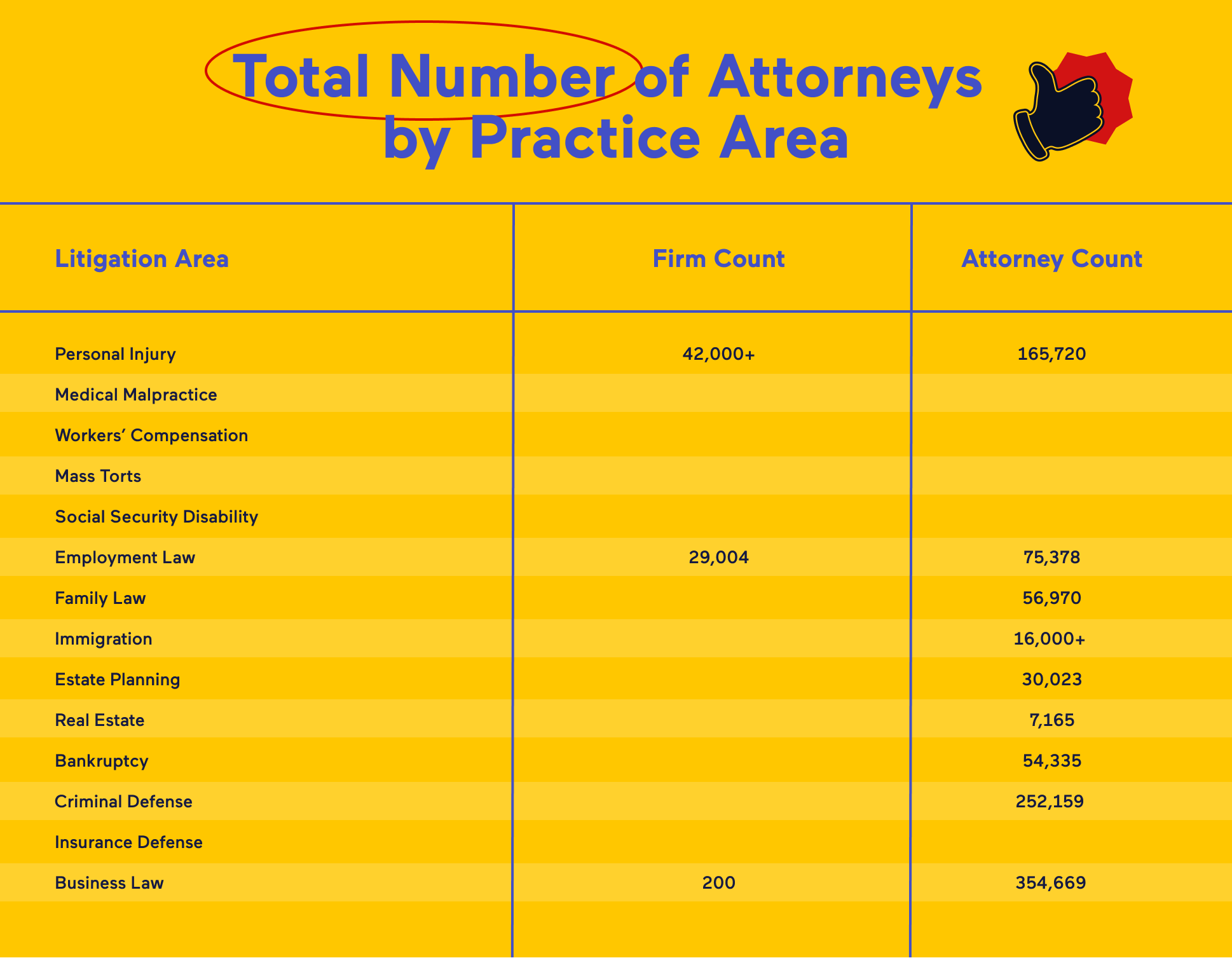
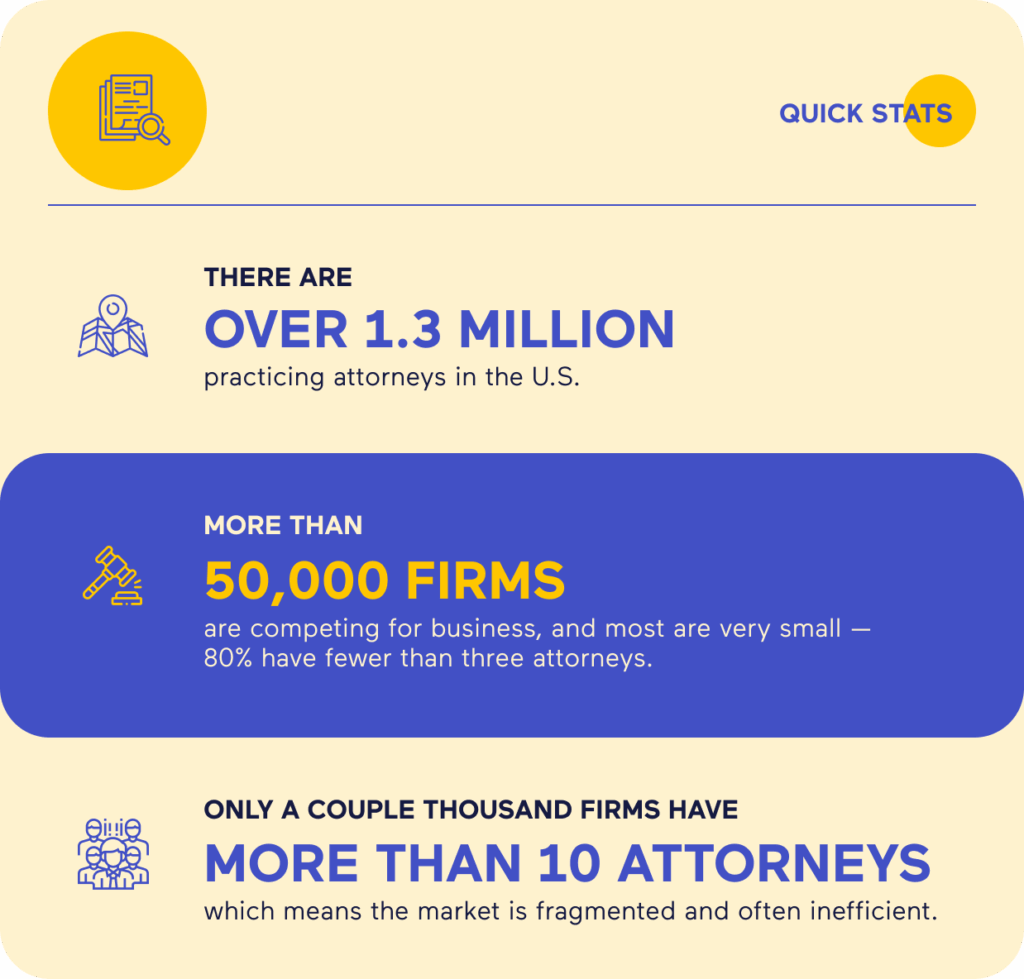
The legal industry isn’t short on lawyers. What matters is knowing how many firms you’re up against (by size, practice area, and geography) and where your firm has room to stand out.
Why Case Type Matters
Competition isn’t uniform. In some practice areas — like personal injury, mass torts, or employment law — marketing costs are high because so many firms are chasing the same clients. In others, like immigration or estate planning, budgets can stretch further because the market is less saturated.
Where your firm practices shapes everything: how much you’ll spend, which channels make sense, and how quickly you can expect ROI.
Why Geography Matters
State-by-state numbers matter too. A quarter of all lawyers in the U.S. are concentrated in New York and California, while smaller states (or states with fewer residents) may only have a few hundred active attorneys. Competing in Manhattan looks very different than competing in Des Moines.
The bottom line:
Before you plan campaigns or set a budget, you need a clear-eyed view of what cases you’re competing for and who else is in the fight. Otherwise, you’re throwing darts in the dark — and your competitors will eat your lunch.

Define Your Value Proposition
Here’s the truth: clients don’t care that you’re a law firm. They care about why you’re the law firm they should call. If you can’t answer that in a sentence or two, you’re already losing ground.
Your value proposition is what sets you apart in a sea of firms that all look the same on paper. It’s the “why us” that makes a client pick up the phone, and the reason a referral partner sends cases your way instead of the shop down the street.
Get it wrong, and you’re just another name in the Google results. Get it right, and you’re the firm people remember before they even need a lawyer.
A strong value proposition works on three fronts: clients, other firms, and vendors. Each group wants something different, and your marketing has to show you can deliver.

For potential clients:
-
 Make clear what you actually offer and why it matters.
 -
Show why you’re the better choice than the firm down the street.
-
Be upfront about fees, especially if you work on contingency.
-
Highlight your attorneys’ track record and responsiveness.
-
Use testimonials and case examples that feel real to the client’s situation.

For other firms (referrals):
-
Demonstrate a history of winning big verdicts in the types of cases you want referred.
-
Be clear and competitive with referral fees.
-
Prove you have a reputation for paying promptly and communicating clearly.
For vendors:
-
Relationships go both ways. Show that you send referrals back when you can.
-
Build a reputation for paying invoices on time.
-
Make it easy to work with you.
-
Lean on your history of long-term partnerships.
At the end of the day, your value proposition isn’t a tagline. It’s proof — the kind of proof that convinces clients, peers, and vendors that working with your firm will pay off.
Exercise:
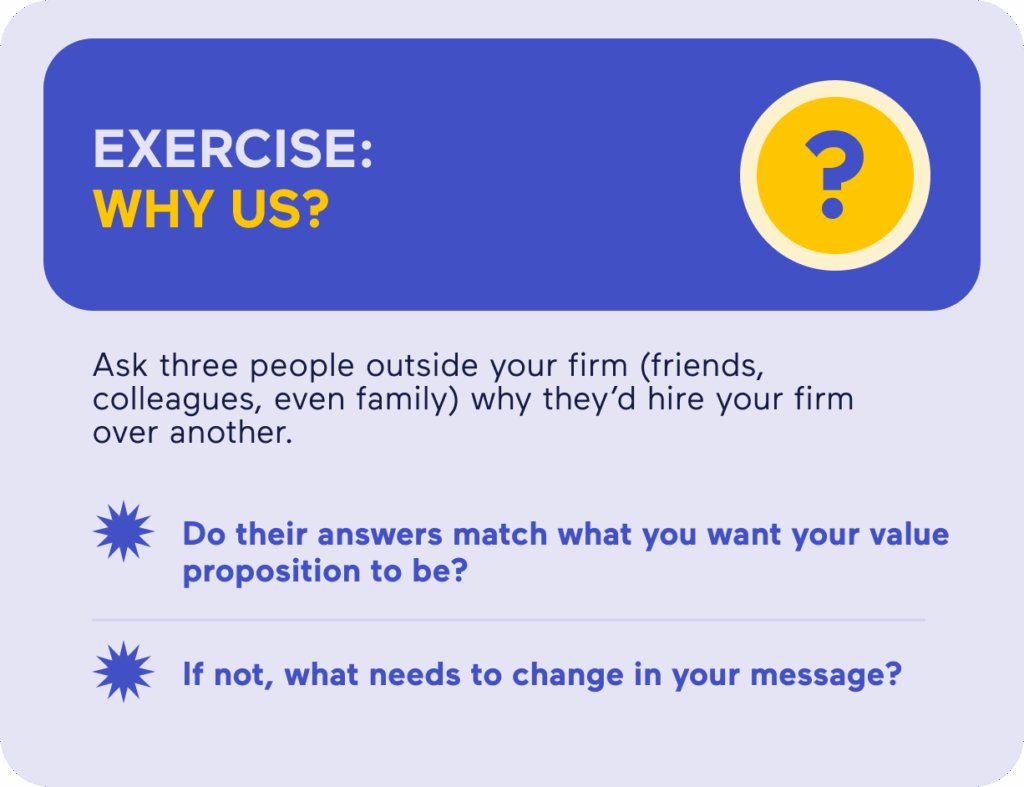
The 10-Second Test

If you can’t say “yes” to all three, refine it until you can.
Differentiate Your Brand
Here’s a simple test: take a look at your logo. If you pulled it off your ads, would people still know it’s you? If the answer is no, then your “brand” isn’t doing its job.
Brand differentiation is what makes a client remember you before they even start Googling. It’s why someone calls your number first, why another lawyer sends you a referral, and why your ads don’t just blend into the wallpaper.
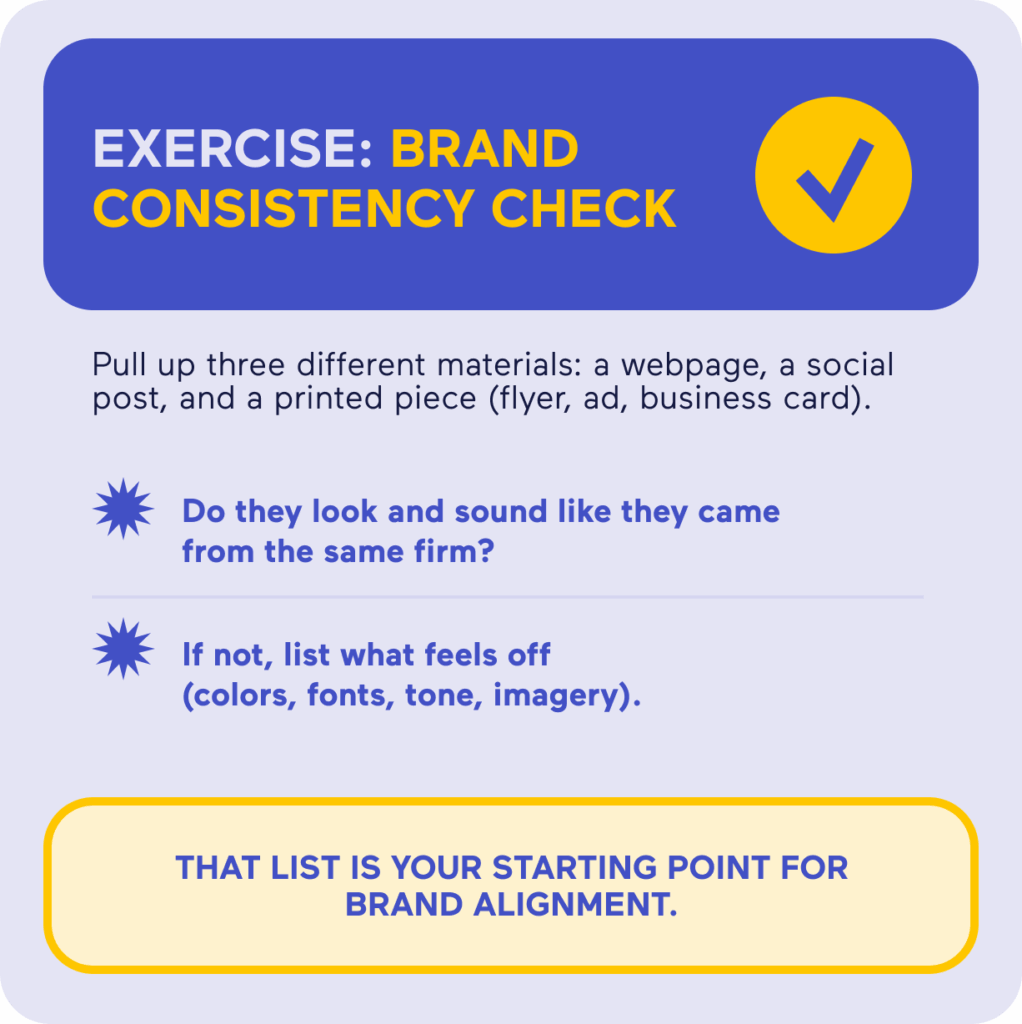
Consistency is everything. Your website, logo, social media, billboards, TV spots, intake scripts: it all has to line up. We know that one off-brand piece can harm a campaign overall, so one thing we do is create “brand bibles” with our clients: a strategy that keeps our entire team focused on distinguishing your firm from the competition.
Exercise:
Brand Blindfold

If the answer is “no,” write down one element (color, tagline, tone, or style) that could make it unmistakably yours.
What Are The Most Common Marketing Strategies for Law Firms?
Law firms have more ways than ever to get in front of clients. Some channels are old-school, some are shiny and new, but they all fall into four main pillars. Ignore any of them completely, and you’re leaving cases on the table.
Traditional Media
Think TV, radio, print, and billboards — the classics. They’re expensive, they’re loud, and when they work, they work big. Traditional media is all about reach and frequency: blasting your name into people’s heads long before they ever need a lawyer.
Why it matters: If you want to be the lawyer people already know when they get into an accident, this is the play.
Earned Media
This is the attention you don’t pay for directly: news coverage, guest spots, speaking gigs, thought leadership. It’s slower to build but carries more credibility than a paid ad ever could.
Why it matters: Judges, juries, and clients all Google you. (They’re not all supposed to, but let’s face it — they all do it.) If the first thing they see is a local news article quoting you, that can put you ahead of the game.
Digital Marketing
SEO, paid search, social ads, email campaigns, video content — basically everything that happens on a screen. Digital marketing is targeted, measurable, and where most firms either sink or scale.
Why it matters: If your website doesn’t rank, your ads don’t convert, and your intake system can’t keep up, you’re invisible to the majority of potential clients.
Business Development
Referrals, partnerships, networking, community sponsorships. This is the oldest strategy in the book, and still the most common. It’s not flashy, but when you build strong relationships, the cases flow.
Why it matters: Even the biggest ad spenders rely on referrals. It’s the difference between being known in the market and being trusted in the market.
None of these strategies exist in a vacuum. The firms that win aren’t the ones who dabble in one or two; they’re the ones who build an integrated mix that plays to their strengths and market position. Not sure where to start? Get you a Pug that can do all of it. 😉
How to Create YOUR Ideal Law Firm Marketing Strategy
Your law firm’s marketing strategy is the blueprint for how you attract clients, build your reputation, and increase your reach — and your revenue — over time. You need to define who you’re speaking to, what message you’re sending, and how you’ll compete in a crowded market. Miss any of these pieces, and you’re basically setting fire to your ad spend.
Understand Your Target Audience
A lot of attorneys we’ve worked with want to cast a wide net because their clients are diverse. But if your marketing is aimed at “everyone,” it’s aimed at no one. Law firms that don’t define their audience waste money chasing clicks and calls they can’t even handle. Your marketing dollars should be laser-focused on the people most likely to hire you, refer to you, or work with you.
Consumer vs. Business Audiences
The first distinction is whether your clients are individuals or businesses.
Consumer-facing (B2C):
personal injury, mass torts, family law, immigration, employment, workers’ compensation, criminal defense. These clients are usually in crisis. They’re scared, stressed, and looking for someone to take control. Your marketing needs to build trust and urgency.
Business-facing (B2B):
corporate defense, IP, transactional, compliance. These clients are executives or in-house counsel. They don’t care about your TV ad jingle — they want proof you’ll protect the bottom line. Messaging here is about ROI and credibility.
Mixed practices:
If you do both, you can’t cram everything onto one site and call it a day. Each audience needs its own strategy — sometimes even separate websites or microsites
Segmentation by Case Type
Even within B2C or B2B, case type changes everything.
- Personal Injury: accident victims and their families; messaging is about protection, recovery, and results.
- Mass Tort: people affected by defective drugs/products; messaging is about strength in numbers and fighting corporations.
- Family Law: parents or spouses in conflict; messaging is often about empathy, protection, and outcomes for children.
- Workers’ Compensation: injured employees seeking benefits vs. employers managing claims; messaging is about fairness, financial security, and compliance.
- Business and Transactional: companies handling contracts, deals, and growth; messaging focuses on stability, opportunity, and long-term partnerships.
- Employment Law: workers vs. management; tone and positioning shift completely depending on which side you serve.
- Whistleblowers and Qui Tam Cases: insiders exposing fraud; messaging is about courage, accountability, and protection from retaliation.
- Immigration: individuals vs. employers; messaging differs depending on whether you’re helping families or corporations.
- Securities Arbitration: investors vs. brokers or firms; messaging is about fairness, restitution, and holding financial institutions accountable.
- Criminal Defense: individuals facing charges; messaging is about rights, freedom, and protecting the future.
- Social Security Disability: individuals unable to work, or caretakers; messaging is about security, dignity, and accessing deserved benefits.
- Estate Planning and Probate: families managing wealth and legacy; messaging focuses on stability, clarity, and peace of mind.
Pro tip:
Build separate campaigns (and often separate landing pages) for each major case type. Trying to speak to everyone in one ad or page is how you end up sounding like no one.
Targeting Attributes
Once you know the big buckets, you refine. Modern advertising lets you get granular, but only if you know what to look for.
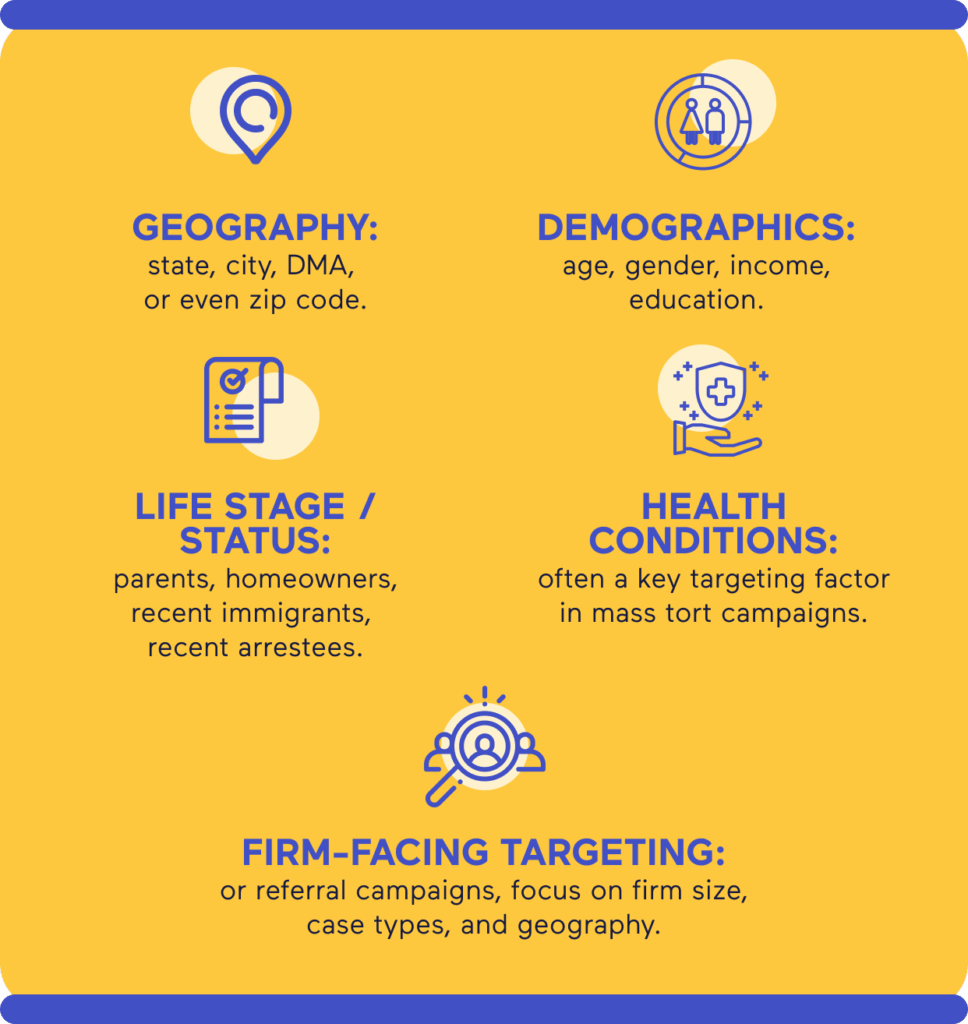
Persona Building
One way to sharpen targeting is to build a few “personas” — fictional stand-ins for your ideal clients.
- Accident Andy – 38, warehouse worker, injured in a truck accident, worried about paying bills. What he wants: financial relief and a lawyer who will handle everything so he can focus on recovery.
- Divorce Darren – 45, mid-level manager, in the middle of a contentious custody dispute, concerned about protecting his kids and assets. What he wants: stability for his children and a fair division of assets without dragging the fight out forever.
- Corporate Carl – 52, GC of a mid-sized tech company, shopping for outside counsel to handle compliance. What he wants: trusted legal partners who can reduce risk and free up his in-house team.
- Mass Tort Maria – 34, mother of two, dealing with medical complications from a defective drug, motivated by both justice and financial security. What she wants: accountability for the manufacturer and enough compensation to secure her family’s future.
- Probation Pete – 27, recently arrested for a DUI, anxious about jail time and losing his job. What he wants: a second chance; someone who can minimize penalties and keep his life from spiraling.
This exercise isn’t about being cute; it’s about gaining clarity. If you can picture exactly who you’re talking to, your ads and content won’t sound generic.
Bottom line:
If you don’t define your audience, everything else falls apart. You’ll waste money on ads that never convert, and your intake staff will get buried in calls from people you can’t even represent. Get the audience right, and everything else clicks into place. You’ll know where to spend, how to prioritize intake, and how to scale without burning cash or staff hours.
Exercise:
Build a Mini Persona
Mapping Your Potential Clients’ Journeys
Clients don’t hire a lawyer in one step. They move through a process, from barely knowing you exist to signing your retainer. Your marketing has to show up at every stage of that journey. If you only cover one or two, you’ll either never get on a client’s radar or you’ll lose them right before they hire you.
Bottom line:
Too many firms over-invest in one stage and ignore the rest. They spend millions on TV ads (awareness) but lose cases because intake drops calls (decision). Or they have polished websites but no brand presence, so clients never find them in the first place. Mapping your consumer journey forces you to cover every step — awareness, consideration, and decision — and makes sure you’re not bleeding money somewhere in the funnel.
Sample Client Journey
- Sees your billboard on the highway.
- Later Googles “car accident lawyer near me.”
- Lands on your website.
- Reads testimonials and case results.
- Checks your Google reviews.
- Calls the number on your site.
- Waits on hold (or doesn’t).
- Talks to intake staff.
- Gets a follow-up text with an e-sign retainer.
- Signs and becomes a client.
Sample Client Journey
- Hears your name at a conference or from a peer referral.
- Googles your firm + “compliance counsel” to do a quick credibility check.
- Scans your website for attorney bios, thought leadership, and client list.
- Reads your LinkedIn articles or sees a partner quoted in a trade publication.
- Reaches out through email or a professional introduction.
- Gets a pitch deck or proposal within 24–48 hours.
- Schedules a call with your partner team.
- Runs your name by the board or executive team.
- Negotiates fee structure and engagement letter.
- Signs on as outside counsel.
Exercise:
Build a Mini Persona
Building Your Value Proposition
As you know, if you can’t clearly explain why someone should hire you instead of the firm down the street, you’re spending money to advertise nothing. But it’s pretty easy to go overboard here, too: you don’t want to get too bogged down.
A good value proposition should:
- Be simple — one to two sentences, max.
- Be specific — no generic “we fight for you.”
- Be proof-driven — tie to results, client outcomes, or measurable advantages.
Common Value Prop Mistakes:
- Generic slogans. “We fight for you,” “Justice for all,” “Here when you need us.” Everyone says that.
- Overcomplicated messaging. If it takes a paragraph to explain, it’s not a value prop.
- Inconsistency. One thing on the website, another in ads, a third out of the intake team’s mouth? That kills credibility. So you want to be consistent in your messaging, no matter where it’s coming from.
Weak example:
-
“We care about our clients.”
Strong example:
-
“We’ve helped over 5,000 accident victims recover more than $200 million in settlements and verdicts.”
How to Pressure Test Your Value Prop
Ask three simple questions:
- Would a potential client understand it in under 10 seconds?
- Does it hold up if a competitor says the same thing?
- Can you prove it with evidence (verdicts, reviews, testimonials, case studies)?
If the answer is “no” to any of these, you don’t have a value prop — you have a tagline.
Build Branded Differentiation
Every law firm says they’re different. Few can prove it. Building a differentiated brand means making conscious choices about how your firm looks, sounds, and shows up, and then sticking to them relentlessly. Here’s how to start:
1. Lock Down Your Identity
- Pick a voice. Jim Adler, “The Texas Hammer,” leans into aggressive, high-energy ads. Love it or hate it, it’s consistent.
- Choose visuals. Morgan & Morgan’s yellow-and-blue scheme makes their ads instantly recognizable across TV, billboards, and digital spaces.
- Document it. Create a brand bible so vendors don’t go rogue with clipart gavels and courthouse steps.
2. Build Recognition, Not Just Awareness
- Repeat yourself. Alexander Shunnarah’s billboards blanket Alabama. Same colors, same face, same name — everywhere.
- Design for memory. Cellino & Barnes (have sense split up – but still a great example) used the same jingle and layout for decades, embedding themselves in local culture.
- Anchor on one hook. Ed Herman’s “3 lawyers eating sandwiches” videos are quirky, memorable, and unmistakably his making Brown & Crouppen both relatable and household names in St. Louis.
3. Audit Every Touchpoint
Pretend you’re a client and test your own brand.
Good example:
-
Mike Morse Law Firm uses “Mike Wins” across billboards, TV, and digital, and their branded phone numbers so the experience feels seamless.
Bad example:
-
Firms that have a slick website built by one vendor, generic ads from another, and intake staff reading a script that doesn’t match either. That’s brand whiplash.
4. Reinforce Through Culture
Your brand isn’t just external. Intake staff, paralegals, even the way attorneys introduce themselves should feel aligned.
- Example: Morgan & Morgan’s “For The People” tagline shows up not just in ads, but in how staff talk about cases internally. It’s become cultural shorthand.
5. Keep It Tight Over Time
Brands drift if no one’s guarding the gates. New campaigns, new partners, and “one-offs” chip away at consistency.
- Example: Morgan & Morgan, Lerner & Rowe, and Sweet James have kept their brands steady across multiple states and markets by holding firm on their visuals and messaging.
- Counterexample: Smaller firms that swap vendors every year end up with disjointed ads and a forgettable identity.
Monitor Your Competition
Law firm marketing isn’t a solo act. Every dollar you spend is up against someone else’s campaign. If you’re not watching what your competitors are doing, you’re basically flying blind while they study your playbook.
Here are the key channels to keep an eye on:
SEO Monitoring
- Backlink analysis: Tools like Ahrefs, Moz, or SEMrush show where competitors are winning links. If you’re not tracking this, you’ll never understand why they’re climbing the rankings.
- Keyword tracking: Ranking for the right keywords isn’t luck. Agencies monitor keywords constantly to prove whether content, technical changes, or link-building are actually working.
Content Monitoring
Want to know what pages other firms are publishing and when? MeanPug literally built a tool that tracks competitor content drops in real time. Knowing what topics they’re chasing helps you see trends early (or beat them to it). Reach out to us if you’d like to see how this works.
Display and Social Ads
- Display ads: Tools like Pathmatics let you spy on competitors’ programmatic creative.
- Social ads: Facebook and Instagram’s Ad Library makes every ad public and searchable by brand or keyword. Mass tort marketers live in this data.
- Example: When a mass tort breaks, you can see exactly how fast big firms pivot their ad spend, and what creative they’re testing.
TV and Out-of-Home (OOH) Advertising
- TV creative monitoring: iSpot.tv lets you see your competitors’ TV ads in near real time.
- TV media monitoring: Media Monitors tracks spend and share of voice, so you can tell who’s buying up slots in your DMA.
- Billboard monitoring: Between centralized tools and mandatory DOT databases, you can check availability, history, and even when new placements pop up. While there are no tools on the market that monitor for billboards going up, good relationships with your reps should be able to get you this data as competitors post new placements.
- Example: Shunnarah’s wall-to-wall billboards didn’t happen by accident. Competitors who weren’t monitoring got boxed out of prime real estate.
Referral Dynamics
This is the “soft” competition: the flow of cases between firms and vendors that often happens behind the scenes. Every firm owner knows some of this anecdotally. The smart ones document it in a live database so new partners and staff aren’t flying blind. For attorney to attorney referrals there are several software providers that help facilitate this process as well: Attorney Share and Lexamica.
Bottom line:
If you’re not actively monitoring competitors, you don’t know when to adjust your own strategy. Legal marketing is brutally competitive, and the sharpest firms test new tactics every day. Sometimes the fastest way to grow is simply to copy what’s working — but you can’t copy what you don’t see.
Exercise:
Competitor Radar

our authors





Sources and References
- Abrams Law Firm. (n.d.). Abrams Law Firm. https://www.abramslaw.com/
- Ahrefs. (n.d.). Ahrefs. https://ahrefs.com/
- Altamirano Law Firm. (n.d.). Altamirano Law Firm. https://www.altlawfirm.com/
- Asbestos.com. (n.d.). Asbestos.com. https://www.asbestos.com/
- Attorney Share. (n.d.). Attorney Share. https://www.attorneyshare.com/
- Bailey Glasser LLP. (n.d.). Bailey Glasser LLP. https://www.baileyglasser.com/
- Crime Victim Law Firm. (n.d.). Crime Victim Law Firm. https://www.crimevictimlawfirm.com/
- Drugwatch. (n.d.). Drugwatch. https://www.drugwatch.com/
- Jacoby & Meyers. (n.d.). Jacoby & Meyers. https://jacobymeyers.com/
- Jeff Murphy Law. (n.d.). Jeff Murphy Law. https://www.jeffmurphylaw.com/
- Jones Day. (n.d.). Jones Day. https://www.jonesday.com/en
- Lanier Law Firm. (n.d.). W. Mark Lanier. https://www.lanierlawfirm.com/attorneys/w-mark-lanier/
- Lerner and Rowe Injury Attorneys. (n.d.). Lerner and Rowe Injury Attorneys. https://lernerandrowe.com/
- Lexamica. (n.d.). Lexamica. https://lexamica.com/
- Media Monitors. (n.d.). Media Monitors. https://www.mediamonitors.com/
- Morgan & Morgan. (n.d.). Morgan & Morgan – For the People. https://www.forthepeople.com/
- Moz. (n.d.). Moz. https://moz.com/
- Panish Shea Boyle Ravipudi LLP. (n.d.). Panish Shea Boyle Ravipudi LLP. https://www.panish.law/
- Porter Simon. (n.d.). Porter Simon. https://portersimon.com/
- Power Rogers, LLP. (n.d.). Power Rogers, LLP. https://www.powerrogers.com/
- Ramos Law. (n.d.). Ramos Law. https://www.ramoslaw.com/
- Semrush. (n.d.). Semrush. https://www.semrush.com/home/
- Sensor Tower. (n.d.). Pathmatics digital advertising. https://sensortower.com/product/digital-advertising/pathmatic
- Sokolove Law. (n.d.). Sokolove Law. https://www.sokolovelaw.com/
- Stark & Stark. (n.d.). Stark & Stark. https://www.stark-stark.com/
- Sweet James Accident Attorneys. (n.d.). Sweet James Accident Attorneys. https://sweetjames.com/
- TopDog Law. (n.d.). TopDog Law. https://topdoglaw.com/
- Wolper Law Firm. (n.d.). Wolper Law Firm. https://www.wolperlawfirm.com/
Essential Law Firm Marketing Terms

A/B Testing: Running two versions of an ad, email, or page to see which performs better.
Attribution: Understanding which channel or campaign actually drove a signed client.
Bounce Rate: The percentage of visitors who leave your site without clicking further.
Brand Differentiation: How you make your firm stand out from competitors in tone, style, and message.
Call-to-Action (CTA): A clear prompt (button, link, phrase) that directs users to take the next step, such as contacting the firm or booking a consultation.
Call Tracking: Technology that shows which ads, campaigns, or numbers drove calls to your firm.
Click-Through Rate (CTR): The percentage of people who click on your ad or link after seeing it.
Content Marketing: Using articles, videos, guides, and FAQs to attract and educate potential clients.
Conversion: When a lead takes the desired action (calls, fills out a form, books a consult).
Conversion Rate: The percentage of people who visit a page or see an ad who then take a desired action (call, form fill, etc.).
Cost Per Acquisition (CPA): How much it costs you to land a signed client from marketing spend.
Customer Relationship Management (CRM): Software that tracks leads, follow-ups, and client communications.
Earned Media: Press coverage or mentions you didn’t pay for — news stories, interviews, features.
E-E-A-T: Google’s framework for ranking sites: Experience, Expertise, Authority, and Trustworthiness.
Geotargeting: Delivering ads to people in a specific geographic area.
Impressions: The number of times your ad or content is displayed (whether or not someone clicks).
Intake: The process of handling incoming leads, from first contact through signed retainer.
Key Performance Indicator (KPI): Metrics that measure success, like signed cases, cost per lead, or intake response time.
Keywords: Words or phrases that describe the topics your content and ads are built around. They signal to search engines what your page is about.
Landing Page: A standalone web page designed to capture leads for a specific campaign.
Lead Scoring: Ranking leads based on likelihood to convert so intake prioritizes the best cases.
Lifetime Value (LTV): The total revenue one client brings to your firm over the relationship.
Local SEO: Optimizing for local searches (“divorce lawyer near me”), Google Business Profiles, and directory listings.
Local Service Ads (LSAs): Pay-per-lead ads at the very top of search results with the green “Google Screened” badge.
Media Mix Modeling (MMM): A fancy term for a regression model that tests and analyzes the effectiveness of different spend percentages in different channels (TV, PPC, SEO, billboards) to see which combination produces the best results.
Organic Search: Website traffic that comes from unpaid search engine results.
Out-of-Home Advertising (OOH): Marketing outside the home, like billboards, buses, or transit ads.
Owned Media: Content you control directly — your website, blogs, email list.
Paid Media: Ads you pay for — PPC, social ads, TV spots, billboards.
Pay-Per-Click (PPC): Ads where you pay each time someone clicks (e.g., Google Ads).
Retargeting: Ads served to people who’ve already visited your site, reminding them to come back.
Search Engine Optimization (SEO): The process of improving your website so it shows up higher in Google search results. Includes technical fixes, content creation, and backlink building.