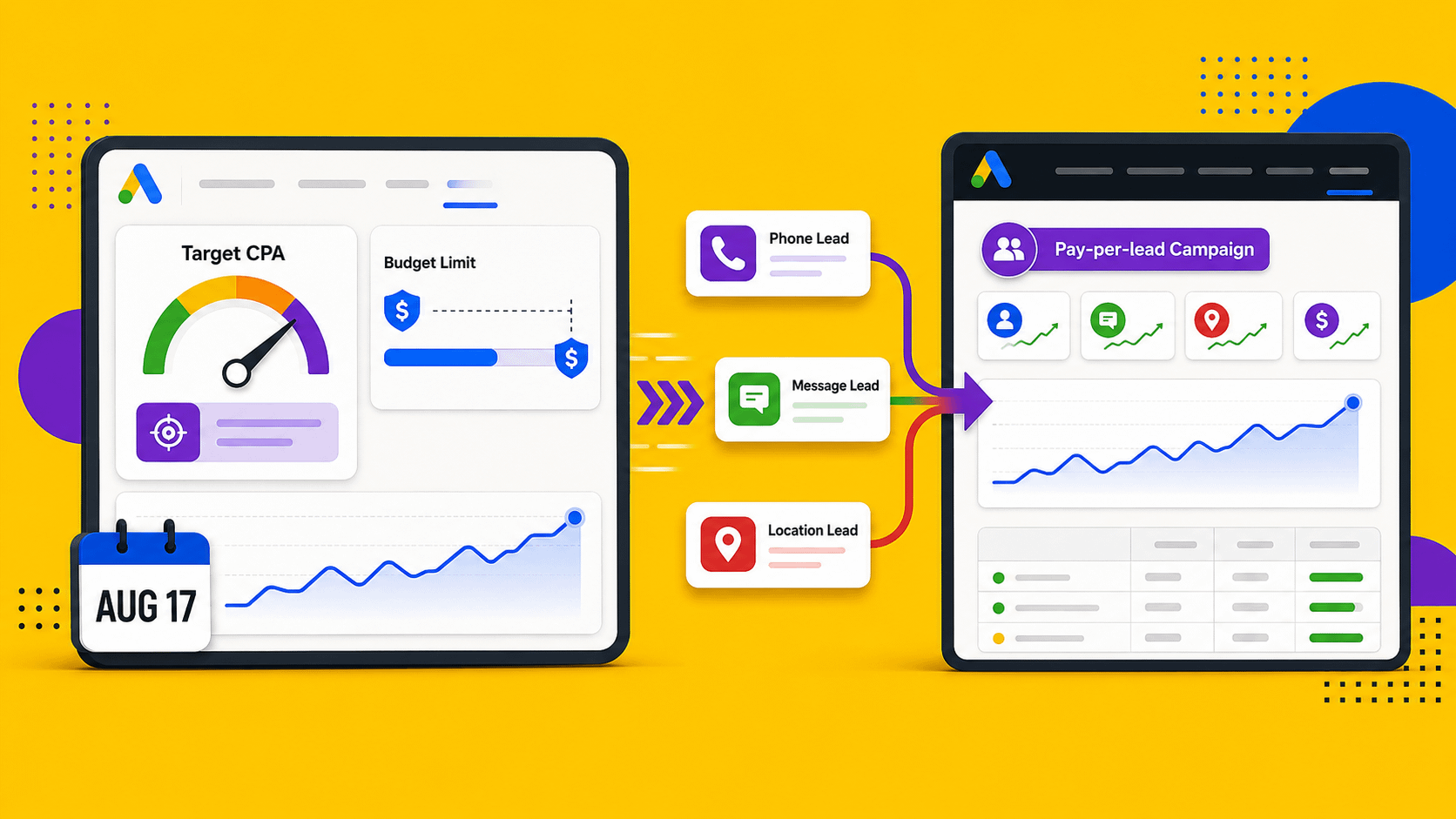
Two Google Ads changes for law firms deserve attention in 2026.
One has a firm deadline: August 17.
The other is a broader transition that will eventually change how law firms manage Local Services Ads, although Google has not announced when legal advertisers will be moved.
These are separate developments with separate timelines. There’s no need to panic about either, but together they give you good reasons to open your Google Ads account, review what is running, and make sure the platform is optimizing toward outcomes that actually matter to your firm.
Here is what law firms should know.
First: Review Budget-Constrained Campaigns Before August 17
Beginning August 17, 2026, Google Ads will change how certain budget-constrained campaigns pursue the performance targets set by advertisers.
The update applies to campaigns that:
- have a “Limited by budget” status; and
- use a target-based bidding strategy, such as Target CPA or Target ROAS.
Today, some of these campaigns perform more efficiently than the targets entered in Google Ads. After August 17, Google says affected campaigns will optimize more consistently toward the stated target, including when an advertiser adjusts the campaign budget.
That may sound like a small technical change, but it could have a larger impact on a campaign that has been outperforming its target.
In its guidance on the bidding change, Google uses an example of a campaign with a $10 Target CPA that has recently generated conversions at an actual CPA of $5. After August 17, that campaign may begin delivering closer to the $10 target unless the advertiser lowers it or selects another target aligned with the campaign’s goals. Target CPA remains an average optimization goal, so individual conversions may cost more or less.
Is Google Automatically Increasing Your Budget?
No.
Google says the update will not automatically increase an advertiser’s daily budget, monthly limit, or bidding target. Campaign budgets will still be respected.
The concern, then, is not necessarily that the campaign will spend more. It’s what the law firm may receive for that spend.
A campaign that previously generated conversions well below its Target CPA could begin delivering closer to that higher target. The firm could spend roughly the same amount overall but receive fewer conversions, experience a higher average CPA, or see temporary performance fluctuations.
Google says campaigns using Target CPA or Target ROAS that are not limited by budget will not change in the same way. You can find more details about which campaigns are affected in the Frequently Asked Questions about the update.
Google Ads Changes for Law Firms: What to Review Before August 17
Law firms and their advertising partners should identify campaigns that are currently marked “Limited by budget” and use Target CPA or Target ROAS.
For each affected campaign, review the following:
The target entered in Google Ads
Does it still reflect an acceptable cost per acquisition or return on ad spend?
A target entered months ago should not remain untouched simply because the campaign has continued running.
Recent actual performance
Compare the stated target with the campaign’s recent CPA or ROAS.
A campaign with a $500 Target CPA that is consistently producing conversions at $300 deserves a closer look before August 17.
What Google considers a conversion
Do your conversion metrics match what is actually happening in intake?
A form submission, phone call, chat interaction, qualified intake, signed retainer, and valuable case are not interchangeable. If Google is being trained to chase the easiest conversion rather than the right case, a technically efficient campaign can still produce poor business results.
That is why effective digital advertising for law firms cannot stop at clicks, calls, or form fills. Advertising data needs to connect with intake and retained-case outcomes.
Lead and case quality
Do not adjust a target based on CPA alone.
Review which campaigns are producing qualified inquiries, which inquiries are becoming retained clients, and which retained matters fit the firm’s case criteria.
A cheap lead is not a victory if nobody at the firm wants the case.
Recent account changes
Look for changes to:
- campaign budgets;
- geographic targeting;
- conversion actions;
- attribution settings;
- landing pages;
- intake processes; and
- bidding strategies.
Recent changes can distort performance data and make a quick target adjustment look more obvious than it really is.
Google has also introduced a Bid Target Adjustment Tool to help affected advertisers compare their targets with recent performance. The tool can be useful, but its recommendation should not replace business judgment.
The right target should reflect the economics of the firm, not simply the number Google would prefer the campaign to pursue.

Google Ads Update for Law Firms: The LSA Migration
The second change has a less certain timeline. Google is beginning a broader migration of Local Services Ads into the Google Ads platform.
Existing LSA campaigns will eventually move into a specialized Performance Max campaign type built around pay-per-lead goals.
That description requires an important clarification: Google is not converting LSAs into ordinary Performance Max campaigns.
According to Google’s LSA migration guidance, several core features will remain the same:
- advertisers will continue paying for valid leads rather than clicks;
- ads will continue appearing in their existing placements on Google Search and Google Maps;
- campaigns will remain keywordless; and
- targeting will continue to rely on service categories, geographic areas, and other account settings.
The biggest immediate difference is where advertisers manage the campaigns.
Budgets, targeting, inquiries, and other settings will move out of the separate Local Services Ads dashboard and into Google Ads.
For law firms managing PPC, LSAs, and other paid channels, that creates a more unified platform. It also introduces new bidding, reporting, and campaign-management considerations.

When Will Law Firm LSA Accounts Move Into Google Ads?
Google is using a phased rollout.
The first phase begins in August 2026 for select home and storefront service advertisers in the United States, including plumbing, HVAC, electrical work, appliance repair, house cleaning, lawn care, roofing, pest control, and moving services.
Broader advertiser groups will follow in late 2026. Google says non-U.S. accounts and all remaining business categories that were not migrated during 2026 will transition in 2027.
Google has not announced a specific migration date for legal advertisers. Law firms should prepare for the transition, but they should not assume their LSA accounts are moving in August.
MeanPug will update this article as additional rollout details become available.
What Will Change When LSA Accounts Move?
Google says the account administrator listed on an LSA profile will receive an email approximately 14 days before the scheduled migration date, followed by another reminder.
Most existing settings will transfer automatically, including:
- targeted locations;
- service types and business categories;
- budget limits;
- ad schedules;
- business photos; and
- verification status.
Other parts of the account will change.
Historical reports will not carry over
Previous LSA performance reports will not transfer into Google Ads. Once an account has migrated, the advertiser will also lose access to the original LSA dashboard.
Law firms should export historical reporting before their transition date.
That data may be necessary to compare performance before and after migration, evaluate market-level changes, and preserve records of lead volume, spend, disputed leads, and campaign performance.
Weekly budgets will become daily averages
Google will convert the existing average weekly budget into an average daily budget by dividing it by seven.
Google says the change will not alter the account’s monthly spending limit, but firms should still document their existing budgets and review the converted amounts after migration.
Manual maximum cost-per-lead bidding will disappear
Google Ads will not support the current manual bidding option that lets an advertiser set a maximum cost per lead.
That could be meaningful for firms that have relied on manual limits to control costs in particularly competitive markets.
Campaign management will become more centralized
PPC and LSA campaigns will live within the same broader Google Ads environment.
Centralization may make account management easier, but it does not eliminate the need to evaluate each channel independently. As we explain in our guide to law firm marketing channels, different channels serve different purposes and should be judged against the role they play in the firm’s broader marketing system.
Could the Google Ads Changes Increase LSA Costs?
Maybe. But anyone attaching a confident percentage to that prediction is getting ahead of the available evidence.
Moving LSAs into Google Ads could eventually affect advertiser participation, bidding behavior, and competition. Google is also simplifying onboarding, which could make the product accessible to more advertisers.
The removal of manual maximum cost-per-lead bidding may change how some firms manage costs.
But Google has not said the migration is designed to increase prices, and there is not yet enough post-migration data to predict what will happen to legal cost per lead or cost per signed case.
The honest answer is that we do not know yet.
What firms can do is preserve their historical data, document their current settings, understand the new controls, and establish a reliable performance baseline before their accounts move.
Then they can judge the migration by what actually happens, not by whatever prediction earns the most clicks.
Two Changes, Two TimelinesGoogle Ads Changes for Law Firms: Two Timelines
The August 17 bidding update requires immediate attention from law firms with budget-constrained Target CPA or Target ROAS campaigns.
The Local Services Ads migration is a broader development. Legal advertisers do not yet have a confirmed transition date, but they should understand what will change and make sure the correct account administrator is receiving Google’s emails.
The practical next steps are straightforward:
Before August 17: Review affected campaign targets, recent performance, conversion quality, and signed-case outcomes.
When Google schedules your LSA migration: Export historical reports, document your settings, confirm the account administrator, and prepare for changes to budgets and bidding controls.
Neither update changes the basic rule of successful law firm marketing: platforms are tools, not strategy.
Google can optimize toward the target you give it. It cannot decide whether that target makes sense for your firm, whether the leads are worth pursuing, or whether your intake team is turning the right opportunities into retained cases.
That part still belongs to the humans.
Is Your Google Ads Account Ready for August 17?
If your law firm is running budget-constrained Target CPA or Target ROAS campaigns, now is the time to review the targets, conversion actions, and case-quality data behind them.
MeanPug helps law firms connect paid media performance with intake and retained-case outcomes, so campaign decisions are based on more than clicks and form fills.
Talk to MeanPug about your Google Ads account.