Law Firm SEO
Long-Term SEO Strategy for Law Firms (Part Seven)
Updated: 07/13/2026

by Andrew Nasrinpay
Partner



Table of Contents
Search changes fast. Strategy shouldn’t.
Most law firms treat SEO like a campaign — a sprint to “rank number one” for a few keywords. That mindset almost guarantees burnout and disappointment. The firms that win over the long term understand that SEO isn’t about chasing trends or updates; it’s about building systems that adapt to change without starting from scratch every six months.
A good long-term strategy makes SEO feel less like guesswork and more like muscle memory.
Building SEO into Firm Culture
When SEO works, it’s because it’s woven into how the firm operates, not bolted on as a side project. Marketing has to be part of the daily rhythm of intake, client service, and even case management.
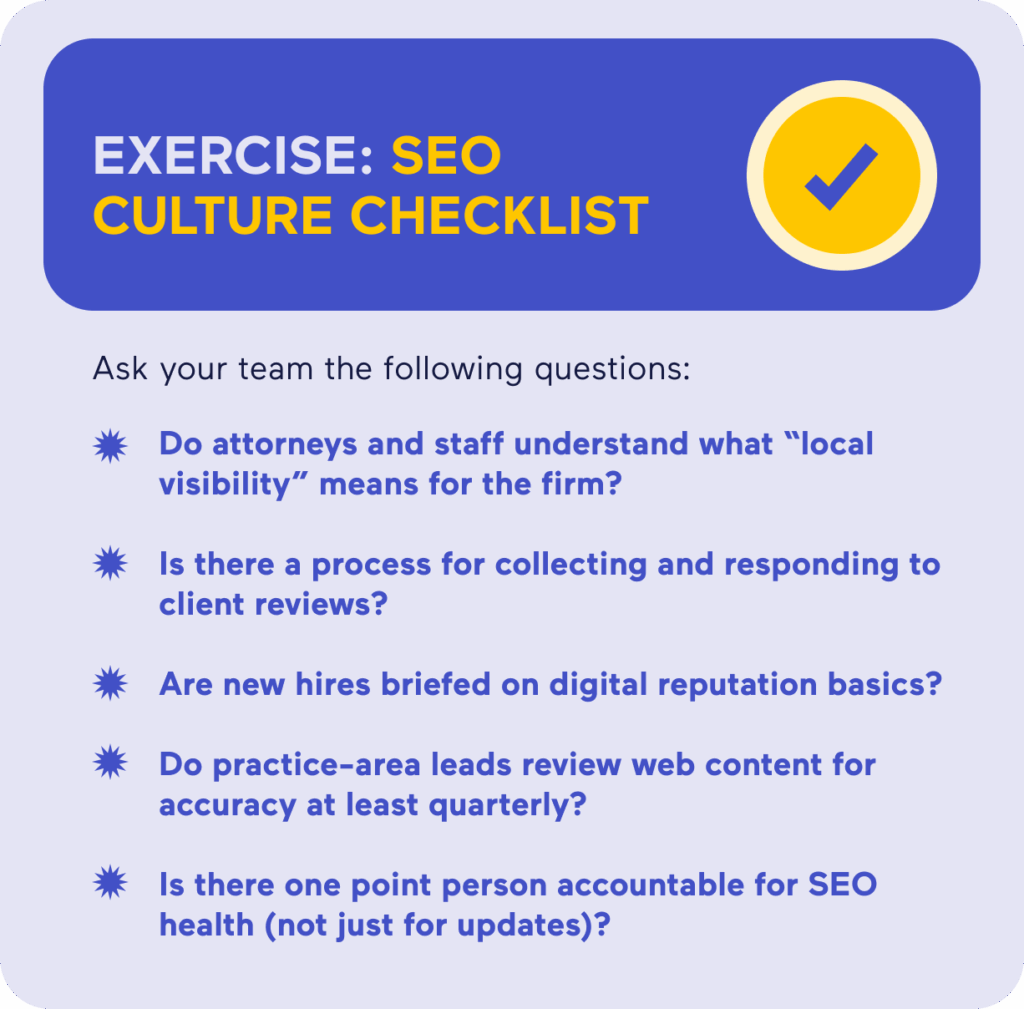
Building that culture starts with shared awareness. Everyone at the firm should understand, at least broadly, how visibility turns into business. Attorneys don’t have to know how to build backlinks, but they should know why testimonials matter or why publishing a short article about a new local ruling helps attract real clients.
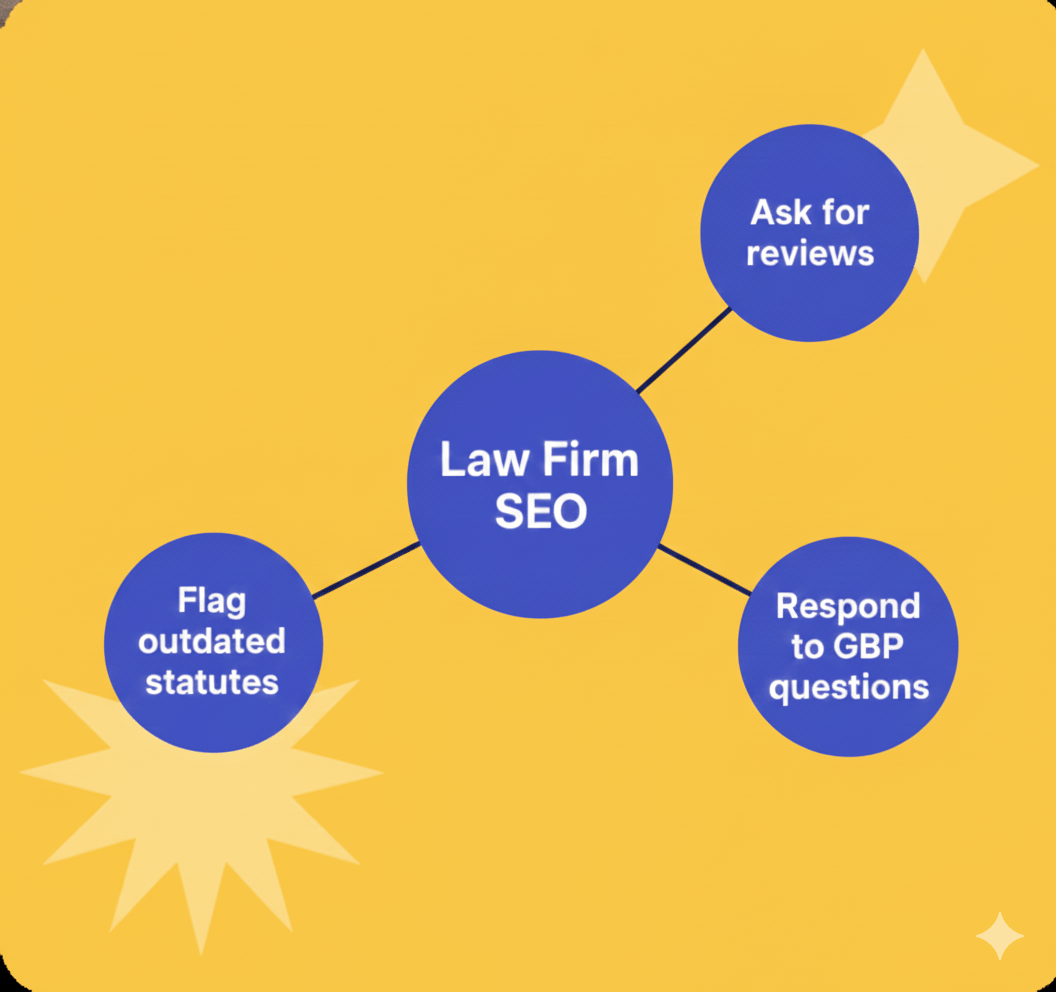
Think of it this way: every person who interacts with your firm affects search visibility. Intake staff who collect consistent contact info help Google trust your listings. Paralegals who update bios keep your website current. Partners who encourage client reviews help the firm’s reputation work for them instead of against them.
When everyone contributes in small, intentional ways, SEO stops being something “marketing handles” and starts being something the firm does naturally, like answering the phone or filing motions on time.
Adapting to Algorithm Updates and AI Changes
Search engines looove to keep marketers humble. Every time Google announces a “core update,” panic spreads across the internet like someone just yelled “fire” in a crowded server room. In reality, most law firms don’t need to panic — they just need to pay attention.
Core updates usually reward content that demonstrates credibility and usefulness over time. If your site already focuses on clarity, factual accuracy, and client value, you’re fine. But if you’ve been coasting on keyword stuffing and recycled content, an update will expose it.
AI-driven search adds another twist. Generative engines like Google’s SGE, ChatGPT Search, and Perplexity are indexing AND interpreting your site. That means factual precision, readable structure, and consistent branding matter more than ever. If AI can’t summarize what your firm does in a single, accurate line, that’s a signal your content may not be clear enough for humans either.
Treat updates and AI shifts the same way you’d treat a change in local court procedures: inconvenient, but part of the job. Stay informed, adapt when necessary, and don’t rebuild your whole site every time Google rolls out a new change for “funsies.”

Budgeting and Resource Allocation
Law firm marketing budgets are often built like Jenga towers: one wrong move and the whole thing wobbles. Long-term SEO planning helps prevent that.
Start by deciding what kind of growth you actually want. Are you expanding into new practice areas? Opening new offices? Trying to reduce dependence on referrals? Your answers shape how much you should invest in technical optimization, content creation, and link acquisition.
The best budgets are proportional to your needs. Technical SEO might take a big chunk in year one but less in year two. Content and local optimization often need consistent investment because they’re what keep your visibility growing, but if you write solid, in-depth pages at jump, then you only need to maintain them.
If you track your cost per signed case, you’ll start to see which marketing efforts pay off. SEO’s ROI isn’t as immediate as paid ads, but the compounding effect is real. Done right, and you’re building an asset that attracts clients long after the invoice is paid.
Exercise:
SEO Budget Planner

Future-Proofing Your Content and Site
No website is ever truly finished; it’s either being maintained or it’s quietly falling behind. The best way to protect your SEO investment is to treat your content and site health like you would case management — steady, ongoing upkeep that prevents bigger problems later.
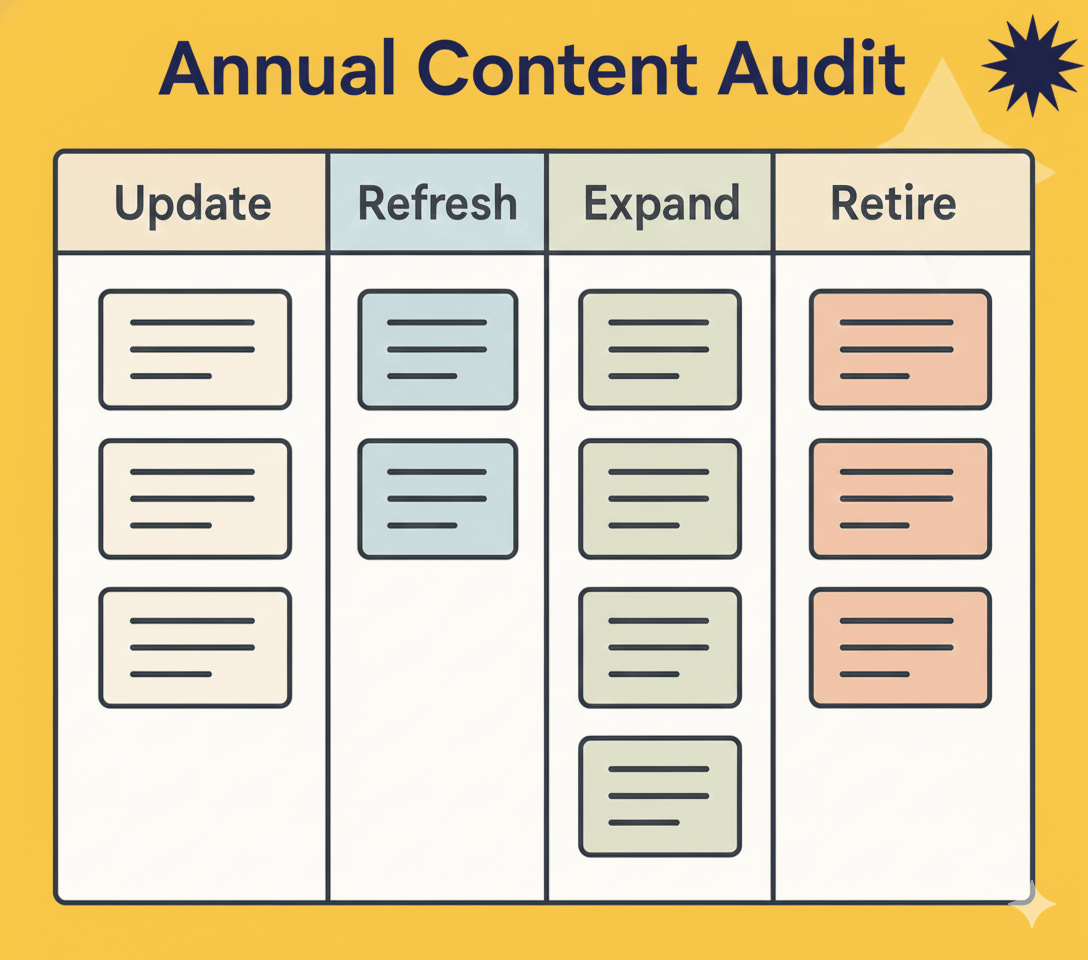
Start with an annual content audit. Flag anything that’s outdated or inaccurate, and note where you’ve overlooked opportunities for fresh material. For law firms, this usually means reviewing pages that reference laws, local procedures, or data that change over time. The goal isn’t to rewrite everything; it’s to make sure what you already have still holds up in court, figuratively and otherwise.
Once the facts are current, turn your attention to usability. Check that the site loads quickly, displays well on mobile devices, and lets visitors find information without effort. It’s not glamorous work, but search engines and clients both notice when a site feels modern and easy to use.
Finally, take stock of your evergreen content — those pages or guides that keep performing long after you’ve forgotten about them. They’re often your quietest but most reliable lead generators. Give them a light refresh when needed: adjust examples, bring statistics up to date, add some graphics or other assets, or smooth out old phrasing. You don’t need to rebuild from scratch; you just need to keep the material breathing.
SEO for Law Firms in 2026: FAQs
How Is SEO for Lawyers Different From Other SEO?
Legal SEO is more competitive, more localized, and held to higher trust standards because it falls under Google’s YMYL guidelines. Ranking requires stronger authorship signals and a deeper understanding of how people hire attorneys in specific markets. Most firms either need an experienced in-house team or an agency built specifically for legal SEO.
Does My Law Firm Need a Website Optimized for Google and Conversions?
Yes — without sound technical foundations, you won’t rank in competitive legal markets. Some firms only need tighter content or a few structural fixes, but others require full technical cleanup. An audit will show whether your site simply needs refinement or a deeper rebuild.
Do You Use “White Hat” SEO Techniques?
Yes. We avoid tactics that put your firm at risk or violate Google’s guidelines. Long-term stability always outperforms shortcuts.
Does Your SEO Include Content?
Yes. High-quality, legally accurate content is the backbone of SEO, especially for YMYL categories like law.
What Is Local SEO for Attorneys?
Local SEO focuses on your visibility in the map pack and local organic results. It’s often the best entry point for smaller firms because proximity, reviews, and relevance heavily influence ranking.
How Can I Appear in the Map Pack?
You need a well-optimized Google Business Profile, consistent local citations, strong reviews, and a website that signals relevance for your practice areas. Proximity plays a role, but optimization and review quality often determine who rises into the top three.
Does Social Media Marketing Help With SEO?
Not directly. Social media doesn’t influence rankings, but strong brand recognition boosts click-through rates — and CTR is a ranking signal. Anything that strengthens brand trust can indirectly support SEO performance.
What Is Content Marketing?
Content marketing is the process of publishing helpful, authoritative material that answers real client questions and builds trust with search engines. For law firms, it includes guides, FAQs, resources, and practice-area pages that demonstrate expertise.
How Long Will It Take Before I Start Ranking on Google?
Getting indexed can happen quickly; earning top-three rankings takes much longer. In competitive markets, it may take months or even years to reach positions that reliably generate high-quality cases.
How Much Does Law Firm SEO Cost?
Pricing for law firm SEO depends on your practice areas, how competitive your market is, and whether you’re aiming for map pack visibility or top organic positions. High-competition categories require more investment to compete with entrenched firms.
Why Is Lawyer SEO Expensive?
Legal traffic is valuable, and competitors invest heavily to capture it. Rankings behave like a winner-take-most system, so firms must invest enough to break into — and stay in — the top tier.
I Tried SEO and It Didn’t Work. How Are You Different?
There are a few reasons why this could be the case:
- The company you hired wasn’t good at their job. (Sometimes the simplest answer is also the right answer.)
- The firm you hired was good, but they failed to give you realistic timelines to rank in the top 3 positions.
- There is low search volume for your particular practice areas. In this instance SEO will likely be a bad idea for your firm.
- You underfunded SEO relative to the competition in your market.
- Your website has technical issues that are significantly hampering your success on SEO.
A clear audit will show which of those factors applied and whether SEO is viable for your practice.
Do I Need a Lot of Reviews to Rank in the Map Pack?
Yes — review volume and quality both drive local rankings. A strong review profile signals trust and improves visibility. Here are a few examples that can impact the quality of each review left:
- Did the reviewer leave a comment or just a star rating?
- How many reviews has that Google account left for all businesses?
- Does that reviewer only have one single Google review?
- Does the review contain the keywords that you are targeting?
- Does the review have images or videos?
How Am I Going to Get Enough Reviews to Compete in My Area?
You need a structured review process that prompts satisfied clients at the right moment. We suggest you start by asking your former clients (or happy current clients) to leave you a review. You can also put a “review us” button right on your website, to make it easier for them. You can also ask your professional network to review their experiences with you; they just have to make it clear that they aren’t clients, or it could be seen as unethical.
Is SEO a Good Investment for Law Firms in 2026?
SEO tends to be either excellent or ineffective — there’s rarely a middle ground. Ranking in the top three produces strong ROI because leads continue long after the investment. Ranking below that threshold typically produces little or no return.
Is SEO Different for Lawyers in 2026 Compared to Previous Years?
Yes. Local SEO is stronger, AI overviews are reducing top-organic click-through rates, and directories are resurfacing as AI-powered answer sources. Strategies that worked five years ago aren’t enough today. Give us a shout to see what we can do to help you upgrade and update your SEO campaign.
How Important Are Links for Law Firm SEO in 2026?
Links still matter, even if Google weighs them differently than in past years. They remain a top-tier ranking signal, especially in competitive markets. Ethical, authoritative links continue to separate strong sites from the rest.
Are We “Too Small” to Work With You?
Probably not. Our retainers start at $2,000 per month, and recommendations are based on what it actually takes to rank in your market. The biggest risk is underfunding SEO and never reaching the positions that generate clients.
Will You Work With My Competitors?
No. MeanPug provides exclusivity by market and case type. For federal practices, exclusivity extends nationwide. Chat with us today and we’ll pull a conflict check to see if we can work with your firm.
Can You Tell My Firm Where to Open New Offices to Get More Cases?
Yes. There are several factors that we look at to recommend where to open a new office for your firm:
- Competition
- Population
- Demographics
- Search Volume
- Overlap with current office local Share of Voice
What Is Crawl Budget, and How Can It Be Optimized for Law Firms?
Crawl budget refers to how often Googlebot visits and indexes your pages. Optimizing it means removing clutter, fixing technical issues, and ensuring that important pages are easy for Google to reach and understand.

our authors



Sources and References
Glossary

Algorithm – The set of rules search engines use to decide which pages show up (and in what order) when someone searches for something. Google tweaks it constantly just to keep everyone guessing.
Alt Text – A written description of an image that helps search engines and screen readers understand what’s shown. Also handy for accessibility compliance.
Anchor Text – The visible, clickable text of a hyperlink that indicates the topic or destination of the linked page.
Backlink – A link from one website to another. The digital equivalent of a vote of confidence — except sometimes people buy votes, and Google frowns on that.
Bounce Rate – The percentage of visitors who leave your site after viewing just one page. High isn’t always bad, but it’s rarely good.
Call to Action (CTA) – A line that encourages the reader to do something — “Call now,” “Book a consultation,” or “Stop ignoring that ticket.”
Canonical URL – The “official” version of a page when duplicates exist. It keeps Google from thinking you’re plagiarizing yourself.
Citations – Mentions of your business name, address, and phone number (NAP) on other sites. Consistency is key.
Click-Through Rate (CTR) – The percentage of people who click on your search result after seeing it. A decent test of whether your title actually says something useful.
Content Marketing – Creating useful, informative content that attracts potential clients without sounding like an ad.
Conversion – When a visitor does what you wanted them to: calls, fills out a form, or schedules a consult.
Conversion Rate – The percentage of visitors who actually convert. A truer measure of success than traffic alone.
Core Web Vitals – Google’s measure of site performance: speed, responsiveness, and stability. Translation: make your website load fast and stop shifting when people scroll.
Crawl – The process search engines use to find and read your site’s pages. If they can’t crawl it, they can’t rank it.
CTR (Click-Through Rate) – Same as #9, but it’s worth repeating: impressions don’t matter if no one clicks.
Directory Listing – Your profile on legal or business directories like Avvo or Yelp. Think of it as a modern-day phone book, but less trustworthy.
Disavow – The act of telling Google, “Please ignore these shady backlinks; we didn’t ask for them.”
Domain Authority (DA) – A third-party metric predicting how likely your site is to rank. Not an official Google score, but marketers love to argue about it anyway.
Duplicate Content – Identical or near-identical text that appears on multiple URLs. Search engines don’t like déjà vu.
Engagement – Any meaningful action a user takes on your site — clicking, reading, sharing, calling. The opposite of scrolling past.
Evergreen Content – Content that stays relevant over time. Not “news,” but the stuff that keeps earning traffic years later.
Featured Snippet – That boxed answer at the top of Google results. Great visibility, terrible for click-throughs.
Footer Links – Links at the bottom of your pages. Fine in moderation, spammy in excess.
Geo-Targeting – Focusing your marketing on users in specific locations. Critical for firms that serve defined geographic areas.
Google Analytics 4 (GA4) – Google’s platform for tracking traffic, engagement, and conversions. It’s powerful, and occasionally infuriating.
Google Analytics – The tool that measures your website traffic and user behavior. The foundation of digital performance tracking.
Google Business Profile (GBP) – The listing that controls how your firm appears in Google Maps and the Local Pack. Keep it updated, or someone else’s will be.
Google Search Console (GSC) – The tool that tells you how your site performs in search. If Analytics is the “what,” Search Console is the “why.”
Headings (H1, H2, H3) – Structural tags that tell readers and search engines what each section is about. Formatting with purpose.
HTML – The code that structures web pages. You don’t have to be fluent, but knowing a few words helps.
Impressions – How many times your page appears in search results. Think of it as visibility, not engagement.
Indexing – When search engines add your page to their database. If you’re not indexed, you’re invisible.
Internal Links – Links between your own pages. They help users navigate and help Google understand your site hierarchy.
Keywords – The search terms people use — and the ones you want your site to rank for.
Keyword Stuffing – Overusing keywords in an attempt to manipulate rankings. Google banned that party years ago.
Landing Page – A page designed to capture leads or conversions, usually tied to a specific campaign.
Link Building – The process of earning backlinks. When done right, it’s relationship-building; when done wrong, it’s spam.
Local Pack – The box of map results that appear at the top of local searches. It’s prime real estate for law firms.
Long-Tail Keyword – A longer, more specific search phrase, like “car accident lawyer in Buffalo, NY.” Lower volume, higher intent.
Meta Description – The short summary under your page title in search results. It doesn’t directly affect ranking, but it does affect clicks.
NAP (Name, Address, Phone Number) – The trifecta of business info that must be consistent everywhere.
NoFollow Link – A hyperlink that tells search engines not to pass ranking credit. Still useful for traffic, less so for SEO power.
Organic Search – Visitors who find your site naturally, not through ads. The slow burn that pays off long-term.
PageSpeed – How quickly your site loads. Faster is better for both rankings and impatient clients.
Schema Markup – Code that helps search engines understand your content. It’s the difference between “I have a website” and “I have a structured, searchable website.”
SERP (Search Engine Results Page) – The page of results you see after searching. Your battleground.
Sitemap – A file that lists all your site’s pages so search engines can find them easily.
Structured Data – A more formal term for schema. It gives Google context — who you are, what you do, and where you do it.
Title Tag – The headline that appears in search results and browser tabs. It’s the digital version of your elevator pitch.
User Experience (UX) – How pleasant and intuitive your website feels to use. If visitors leave frustrated, no amount of keywords will save you.
Zero-Click Search – When Google answers a query directly on the results page, leaving your beautifully written article unclicked but still useful.