
There is no universal timeline for deciding when to switch law firm marketing agencies. Six months may be a reasonable checkpoint for some campaigns, while others require more time to produce meaningful results. The appropriate timeline depends on your goals, the marketing strategies involved, your starting point, and the competition in your market.
That makes the decision to replace a marketing company more complicated than most people would like. Sometimes impatience masks unrealistic expectations. Other times, “give it more time” becomes a way to avoid addressing deeper problems.
The question isn’t simply how long you’ve worked with an agency. It’s whether the agency is making reasonable progress, meeting its commitments, and addressing the problems that could prevent your marketing strategy from succeeding.
Why Law Firm Marketing Timelines Vary
A firm launching a new website and building its first organic search presence shouldn’t expect the same results on the same timeline as an established practice refining an existing advertising campaign. Even firms using similar strategies can experience different outcomes depending on their starting conditions, resources, and competition.
Several factors influence how quickly a law firm can reasonably expect progress:
| Factor | How It Affects the Timeline |
|---|---|
| Type of marketing program | Paid advertising can begin generating inquiries relatively quickly once campaigns are active, although improving lead quality and acquisition costs requires ongoing testing and adjustments. SEO generally takes longer, particularly when a firm needs substantial content development, technical improvements, or greater search visibility. Google notes that changes can take weeks or months to show their effects in search results, and not every change produces a noticeable improvement. |
| Existing website and market presence | A firm with an established domain, relevant content, and strong local visibility has a different starting point than a new practice with little online presence. |
| Competition and budget | A modest advertising budget in a highly competitive personal injury market may limit how quickly an agency can gather enough data to evaluate performance and make informed adjustments. Organic growth may also take longer when established competitors dominate relevant searches. |
| Campaign maturity | A strategy that’s been running for several years should be evaluated differently from one launched recently. Expanding into a new practice area may also require building visibility and reaching a different audience. |
| Implementation delays | A campaign shouldn’t be evaluated solely by the date the agency was hired. Website development, tracking problems, delayed content approvals, and other obstacles can affect when the work begins producing meaningful data and results. |
These factors help explain why a particular timeline might be reasonable. They don’t automatically justify every delay. Even when results take time, an agency should be able to demonstrate what work has been completed, what the available data shows, and what steps are being taken to move the strategy forward.
Consider a firm that hired an agency six months ago to launch a new website and begin an SEO campaign. If the website went live only eight weeks ago, the organic strategy hasn’t had six months to develop. But that doesn’t necessarily mean the agency has performed well. If the launch was delayed because the firm repeatedly postponed approvals, that’s different from a delay caused by missed agency deadlines or incomplete work.

When Should You Give Your Marketing Agency More Time?
Giving a marketing agency more time can make sense when the program is still developing and there’s evidence that the strategy is moving in the right direction. That doesn’t mean every metric needs to improve each month. It means the agency should be able to connect the work being performed to the original strategy, explain what the results show so far, and identify what reasonable progress looks like at that stage.
For example, a law firm entering a competitive practice area may spend its first several months developing service pages, improving its website, and building search visibility. The absence of substantial organic inquiries during that period isn’t necessarily evidence of failure, particularly if the agreed-upon work is progressing and early indicators support the strategy.
The same principle applies to paid advertising, although the evaluation is different. An agency may need time to test keywords, advertising messages, geographic targeting, and landing pages to determine which combinations attract the right cases. But continued spending should produce useful information. The agency should be able to explain what’s working, what isn’t, and how those findings are shaping campaign adjustments. Months of spending without meaningful analysis or changes are harder to justify.
Law firms also need to consider what happens after an inquiry arrives. Clio’s research on solo and small law firms found that firms using certain digital intake tools experienced improvements in client conversion rates, reinforcing the importance of evaluating what happens after a prospective client makes contact. A campaign targeting complex FINRA arbitration, for example, may generate fewer opportunities than a campaign targeting a broader practice area. Evaluating that campaign exclusively by immediate signed-case volume could overlook qualified inquiries that are still being evaluated or pursued. Conversely, a high volume of inquiries means little if intake records show that most callers need services the firm doesn’t provide.
More time is generally easier to justify when:
- The campaign is still within the development period originally discussed.
- Agreed-upon work has been completed or is progressing on a reasonable schedule.
- Early results provide useful information, even if the ultimate business goals haven’t been reached.
- Delays or obstacles have identifiable causes and are being addressed.
- The agency can explain what it expects to learn, improve, or accomplish before the next evaluation.
These conditions don’t guarantee that the strategy will succeed. They provide a reasonable basis for continuing, provided the firm and agency understand what progress should look like and when they’ll evaluate it again.
When Is It Time to Set a Deadline for Improvement?
When a marketing agency isn’t meeting expectations, replacing it immediately may not be necessary. But continuing without a clear plan for improvement can waste time and money. A defined improvement period gives the agency an opportunity to address specific problems while establishing a reasonable point for the firm to reassess the relationship.
Suppose your firm hired an agency to increase inquiries for serious truck accident cases. After several months, the advertising campaign is generating calls, but most involve minor vehicle damage or matters outside the firm’s case criteria. The agency points to competition and recommends waiting another quarter.
Competition may affect advertising costs and campaign performance, but it doesn’t adequately explain why the firm continues receiving inquiries that don’t match its case criteria. Before agreeing to more time, the firm should expect the agency to investigate the mismatch, identify potential causes, and recommend specific adjustments.
An improvement period should establish:
1. The problem being addressed. Define the concern clearly, whether it’s poor lead quality, missed implementation deadlines, inaccurate tracking, or another issue. Use available performance data and intake records to establish a starting point.
2. The changes the agency will make. Agree on specific corrective actions, such as refining campaign targeting, reviewing search terms, correcting technical problems, or completing overdue work.
3. The firm’s responsibilities. Identify what the agency needs from the firm, including intake feedback, timely approvals, or decisions from leadership, and establish who is responsible for providing it.
4. A reasonable review date. Set a timeframe that allows the corrective work to be implemented and evaluated. The deadline should reflect the nature of the problem rather than an arbitrary number of days.
5. The evidence of improvement. Agree on what will be measured, how progress will be evaluated, and what happens if the problem remains unresolved. For advertising campaigns, that may mean looking beyond call volume to qualified inquiries or signed cases, where reliable tracking is available. Google Ads’ guidance on offline conversions explains how advertisers can measure qualified and converted leads after the initial interaction.
The appropriate length of an improvement period depends on the issue. Correcting broken conversion tracking shouldn’t require the same amount of time as evaluating a revised organic search strategy. Likewise, an agency shouldn’t need months to complete overdue work without a credible explanation.
A defined improvement period replaces vague promises with specific expectations. If the agency follows through and the evidence supports continuing, the relationship may be worth preserving. If commitments repeatedly slip or the same problems persist without meaningful reassessment, the firm has a stronger basis for considering other options.
When Should a Law Firm Consider Switching Sooner?
Some agency problems warrant attention regardless of how long a marketing campaign has been running. While disappointing results may justify further evaluation, serious failures involving spending, account access, reporting, or agreed-upon responsibilities can create risks that make continued waiting difficult to justify.
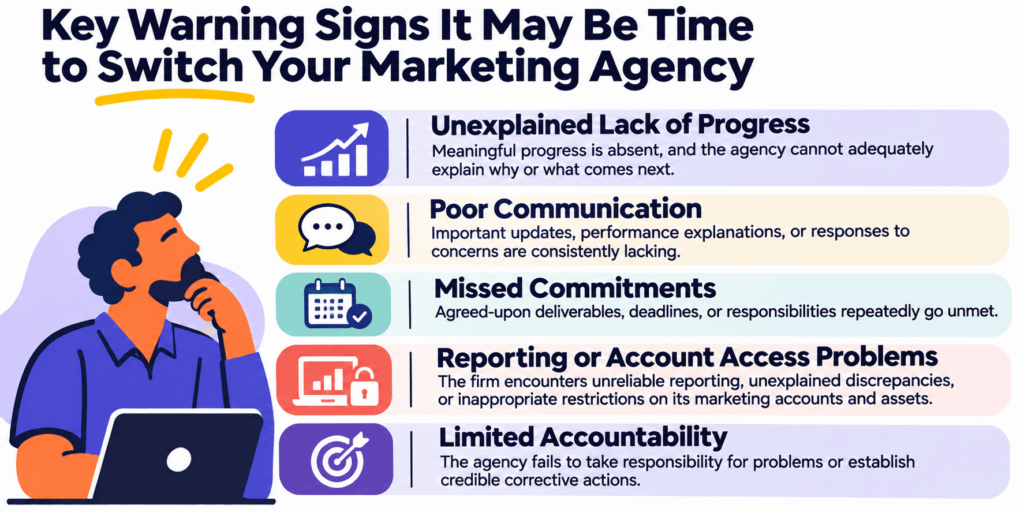
These situations can include:
Unauthorized spending or changes to agreed-upon services: The agency incurs expenses or makes material changes to the marketing program without obtaining required approval from the firm.
Problems with account access or control: The firm cannot obtain the access it is entitled to under its agreements for advertising accounts, analytics, its website, or other essential marketing assets. This can become particularly problematic when the firm needs to review campaign performance or prepare for a transition. Google Ads provides guidance on account access and ownership, including how access works when an advertising account is managed through another organization.
Repeated failure to complete agreed-upon work: Major deliverables remain incomplete despite clear commitments, follow-up discussions, and reasonable opportunities to resolve the issue.
Serious reporting or tracking concerns: The agency cannot substantiate important performance claims, provides materially inconsistent reporting, or fails to address known tracking problems that undermine the reliability of campaign data.
Failure to address significant problems: The agency repeatedly avoids investigating or correcting serious issues, even after the firm has raised its concerns and provided reasonable opportunities for resolution.
“These concerns are different from a campaign that simply hasn’t reached its performance goals. They raise questions about whether the agency is fulfilling its responsibilities and whether the firm can reasonably rely on its work and reporting.”
That doesn’t mean every serious disagreement requires immediate termination. Before making a change, the firm should review its contract, clarify ownership and access rights for essential marketing assets, and identify any dependencies that could complicate a transition. Advertising accounts, analytics properties, website infrastructure, and historical campaign data may be governed by different contractual arrangements.
A poorly planned transition can interrupt active campaigns, compromise reporting continuity, or delay important website updates. Taking inventory of essential accounts and coordinating access before ending the relationship can help reduce those risks. In some cases, beginning to evaluate alternative agencies while preparing for a potential transition is more prudent than continuing to wait for performance to improve.
How Should You Decide Whether to Wait, Intervene, or Switch?
Before deciding whether to continue with a marketing agency, compare its performance and responsibilities against the expectations established when the relationship began:
Review the original agreement, project timelines, performance reports, and other relevant records where available. If expectations were never clearly established, defining them may be more productive than assuming the agency has missed an agreed-upon deadline. If your firm’s goals have changed, the strategy may also need to be reassessed before its performance can be judged fairly.
From there, the decision generally falls into one of three categories:
| Decision | What Supports It and What to Do Next |
|---|---|
| Give the agency more time | The strategy is still developing, agreed-upon work is progressing, and the available evidence supports continued investment. Confirm upcoming milestones, expected indicators of progress, and the next review date. |
| Set a defined improvement period | Specific problems have emerged, but the agency has a credible plan to address them within a reasonable timeframe. Document the corrective actions, responsibilities, measures of improvement, and review date. |
| Consider a transition | Serious problems require prompt attention, or the agency has repeatedly failed to address concerns despite reasonable opportunities to improve. Review contractual obligations, confirm access to essential marketing assets, and begin evaluating alternatives. |
Likewise, disappointing results don’t automatically establish that an agency has failed to perform its work.
The decision should account for what the agency committed to deliver, what it has accomplished, how it responds to problems, and whether the relationship still supports the firm’s business goals.
Make Your Next Marketing Decision With Better Information
Deciding whether to replace your law firm’s marketing company shouldn’t come down to how many months you’ve worked together. What matters is whether the agency is meeting its commitments, making reasonable progress, and addressing problems when they arise.
Some strategies need more time. Others need a clear plan for improvement. And sometimes, the evidence suggests it’s time to consider a different partner. Making that distinction can help your firm avoid unnecessary disruption without continuing to invest in a relationship that isn’t working.
At MeanPug Digital, we help law firms evaluate their marketing priorities, understand where their current efforts may be falling short, and develop strategies focused on attracting the cases they want. If you’re questioning whether your current agency is still the right fit, let’s talk about what your firm needs and what a better approach might look like.