
Your law firm’s marketing has been generating more leads for three consecutive months. Then inquiries drop. Your agency calls it a normal fluctuation, but your partners want answers. Should you increase your budget, change your strategy, or give the current approach more time?
One month of declining results doesn’t necessarily mean your marketing is failing. Three months of growth don’t automatically prove it’s working, either. To understand what’s actually happening, you need to evaluate performance over time, identify what’s driving the changes, and determine whether your marketing is generating meaningful business results.
That means looking beyond traffic, rankings, and call volume. Are you attracting qualified prospects? What does it cost to acquire them? Are those prospects becoming signed clients? And are the results improving enough to justify your investment?
The goal isn’t to wait for a “perfect” trend. It’s to know when the evidence supports staying the course, making adjustments, or changing direction.
Why Marketing Performance Needs to Be Evaluated Over Time
Monthly marketing reports can show you what’s changing, but they don’t always explain why it’s happening or whether those changes matter to your firm’s bottom line.
Consider a personal injury firm that receives 40 qualified inquiries in January, 32 in February, and 45 in March. Looking at February alone might suggest that marketing performance is declining. But March tells a different story: inquiries recovered and even exceeded January’s total. The question is whether that recovery reflects a meaningful improvement or simply normal month-to-month variation.
Before drawing conclusions from those numbers, the firm needs to consider what else may have changed:
- Did the firm increase advertising spend?
- Did its geographic targeting change?
- Were there seasonal fluctuations in search demand?
- Did the number of signed cases follow the same pattern?
Without that context, it’s difficult to determine whether a change in performance warrants a strategic adjustment or simply closer monitoring.
Law firms can make expensive decisions based on incomplete information. A temporary decline might lead to unnecessary changes to an otherwise successful campaign. Conversely, strong lead volume might also create the appearance of success even as the cost of acquiring each signed case becomes unsustainable.
A useful evaluation should help your firm distinguish between:
- Normal fluctuations: Short-term changes that don’t necessarily indicate a larger problem.
- Emerging trends: Patterns that suggest performance is improving or declining.
- Operational problems: Issues with intake, lead qualification, or follow-up that prevent qualified inquiries from becoming signed clients.
- Strategic problems: Persistent results that don’t align with the firm’s business goals, target cases, or marketing budget.
Not every change requires action, but every meaningful change deserves an explanation.
How Often Should Law Firms Evaluate Their Marketing Performance?
There’s no single evaluation schedule that works for every law firm or marketing channel.
Paid advertising can generate measurable responses relatively quickly, while SEO investments often take longer to produce meaningful results. Firms also need to account for the time between an initial inquiry and a signed case when evaluating performance.
A more practical approach is to evaluate performance at regular intervals, with each review focused on different questions and business objectives.
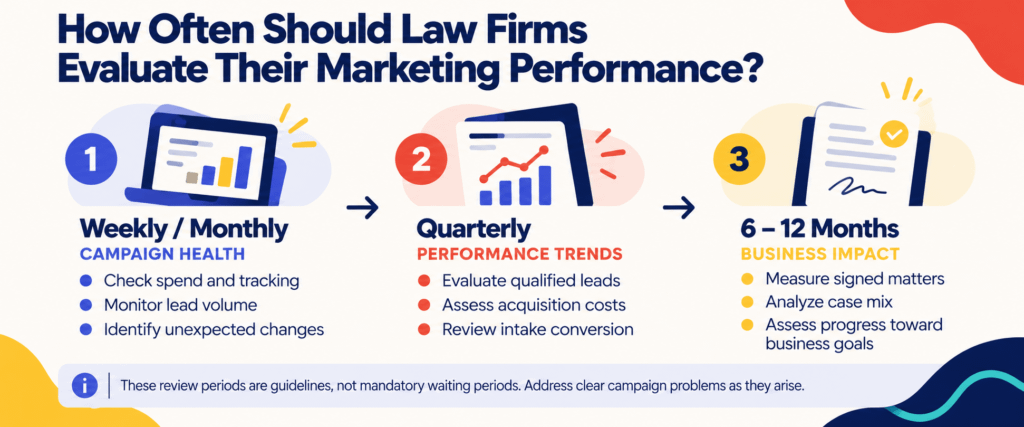
Weekly and Monthly: Identify Problems and Monitor Active Campaigns
Short-term reporting helps firms identify immediate performance issues, monitor active campaigns, and determine whether anything requires attention.
Your agency should regularly review advertising spend, conversion tracking, lead volume, and campaign performance to identify unexpected changes and investigate potential problems.
For example, a sudden drop in calls might indicate a tracking issue, a paused campaign, a technical problem with the website, or an actual change in demand. Each possibility should be investigated before concluding that the marketing strategy is no longer working.
Short-term reviews can also help firms assess whether changes to ad copy, landing pages, or campaign targeting are producing the intended results.
At this stage, useful questions include:
- Are campaigns running and tracking correctly?
- Have inquiries, costs, or conversion rates changed unexpectedly?
- Are we attracting the types of prospects we intended to reach?
- Are recent campaign adjustments producing the intended results?
Some problems require immediate action. Others simply need to be documented and monitored.
The distinction is important. You shouldn’t ignore a broken campaign for three months, but you also shouldn’t abandon a sound strategy because one month’s numbers disappointed you.
Quarterly: Look for Consistent Direction
Quarterly reviews help firms identify broader performance patterns that may not be apparent in individual monthly reports.
At this stage, your firm can begin comparing qualified lead volume, acquisition costs, intake conversion rates, and channel performance across multiple months to identify where results are improving or falling short.
Suppose your firm received 100 qualified leads last quarter and 120 this quarter, a 20% increase. But if marketing spending increased by 40% during the same period, your cost per qualified lead also increased. That’s worth examining before concluding that the campaign is performing better.
The additional investment may still be justified, particularly if those leads are generating higher-value cases. But an increase in lead volume alone isn’t enough to determine whether the campaign is delivering better results.
Quarterly evaluations should help your firm decide where to maintain its investment, where to make adjustments, and which areas warrant closer attention.
Quarterly reviews can also reveal problems that aren’t obvious in monthly reports. If qualified inquiries are increasing but fewer prospects are scheduling consultations, the issue may lie in the intake process rather than the advertising strategy.
Six to Twelve Months: Evaluate Business Impact
Longer evaluation periods can help law firms assess whether their marketing investments are supporting broader business goals. Depending on the practice area, case volume, and available data, a six- to twelve-month review can provide a clearer picture of signed matters, acquisition costs, case mix, and whether marketing is generating the types of cases the firm wants to take on. Broader industry research, including Clio’s 2025 Legal Trends Report, provides additional context for evaluating a firm’s financial and operational performance.
Longer periods also help firms account for seasonal changes in demand and the time it takes for qualified inquiries to become signed cases.
For example, a campaign that generates qualified consultations in September may not produce signed cases until October or November. Evaluating that campaign solely on September’s signed cases could underestimate its contribution to the firm’s growth.
A longer-term evaluation should help your firm answer broader business questions:
- Are we consistently attracting cases that fit our practice?
- Is the cost of acquiring those cases sustainable?
- Which marketing channels are contributing to growth?
- Does our current investment support our staffing and capacity?
- Are we making progress toward the business goals we established?
Six or twelve months isn’t a mandatory waiting period. A campaign with clear problems shouldn’t continue simply because the calendar says it needs more time. The appropriate evaluation period depends on the marketing channel, the available data, and the decision your firm needs to make.
Which Marketing Metrics Matter When Measuring Progress?
Traffic, rankings, calls, and conversions all provide useful information, but no single metric tells the full story. To understand whether marketing is contributing to your firm’s growth, you need to examine how those numbers translate into qualified opportunities, signed matters, and acquisition costs.
Lead Volume and Lead Quality
Imagine that your firm’s monthly lead volume increases from 150 to 200. That looks promising until intake reports that most of the additional inquiries involve practice areas your firm doesn’t handle. More leads don’t necessarily mean more business.
To evaluate lead quality, compare total inquiries with those that meet your firm’s agreed geographic, practice-area, and case-selection criteria. Tracking that relationship over time can help determine whether your marketing is attracting better-qualified prospects or simply generating more inquiries that are unlikely to become clients.
Acquisition Costs and Signed Matters
Cost per lead can help measure campaign efficiency, but it doesn’t tell you how much your firm is spending to acquire a signed client. For a more complete picture, examine the cost per qualified lead and, where reliable data is available, the cost per signed matter.
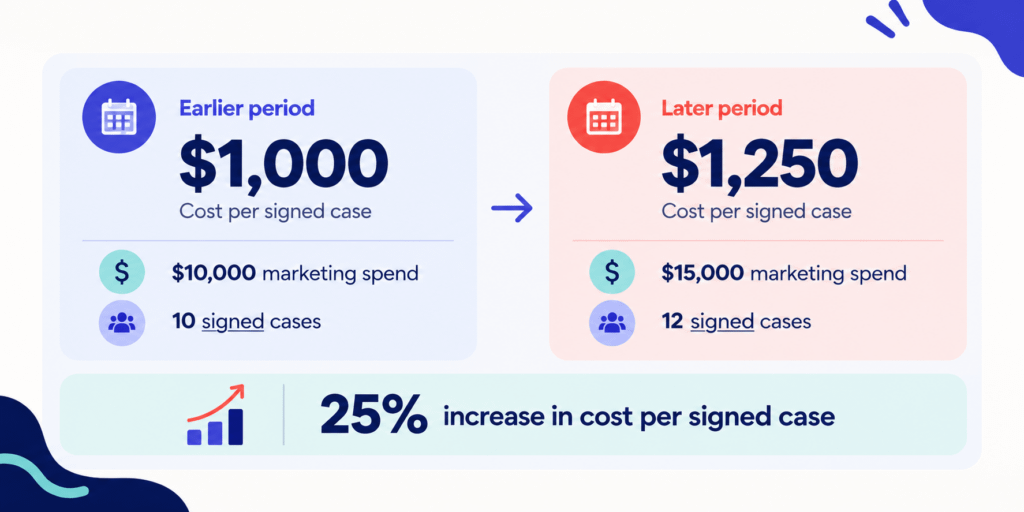
Illustrative example: Although signed cases increased, cost per signed case rose by 25%, from $1,000 to $1,250.
Higher acquisition costs don’t automatically mean the additional spending was a mistake. The newer cases may have greater potential value, or the firm may be investing in a market it wants to develop. Before increasing the budget further, the firm should consider whether the additional investment supports its broader business goals.
Conversion Rates and Intake Performance
Marketing performance doesn’t stop when someone calls or submits a form. If qualified inquiries are increasing but signed matters remain flat, the firm needs to examine what’s happening between the initial contact and the decision to accept or decline representation:
- Are prospects receiving timely follow-up?
- Are consultations being scheduled and attended?
- Are prospective clients declining representation, or is the firm declining their cases?
Each possibility points to a different problem and potentially a different solution.
Marketing and intake data should be evaluated together to determine whether an issue begins with the quality of incoming leads or develops later in the process. Identifying where qualified opportunities are being lost allows the firm to address the underlying problem rather than making changes to its marketing strategy based on incomplete information.
Clio’s 2025 research on solo and small law firms found an association between the use of digital intake tools and stronger lead generation and conversion outcomes. The findings reinforce the importance of evaluating intake performance alongside marketing results.
How to Tell Whether a Performance Change Is Meaningful
Not every increase is progress, and not every decline signals a problem. Before making a major decision, your firm should consider several factors that can change how the numbers are interpreted.
Compare Results Against a Useful Baseline
A performance change only means something when you know what you’re comparing it against. A 25% increase in qualified leads may sound significant, but going from four to five qualified leads is different from going from 80 to 100.
Look at the underlying numbers, the reporting periods being compared, and any changes in marketing spend. Establishing a baseline before launching a campaign, expanding into a new geographic market, or making substantial website changes will also help your firm assess the impact of those investments.
Account for Seasonality and Changes in Demand
Search behavior and demand for legal services can change throughout the year. Seasonal patterns, competitive activity, local events, and broader economic conditions may all affect inquiry volume, even when your marketing strategy hasn’t changed.
Comparing March with February may reveal a different trend than comparing March with the same month in the previous year. Neither comparison tells you the full story on its own. Google Trends provides guidance on comparing search interest across different periods. Your agency should help assess which changes may be related to your marketing efforts and which could reflect broader conditions affecting demand.
Allow for Delays Between Inquiries and Signed Cases
A lead generated this month doesn’t necessarily become a signed client this month. Prospective clients may need additional consultations, documentation, or time to make a decision, and the length of that process can vary by practice area and case type.
When evaluating acquisition costs or signed matters, account for the time between an initial inquiry and a signed case. Comparing this month’s marketing spend only with cases signed during the same month can produce a misleading picture if some leads take weeks or months to convert. Google Ads also documents conversion delays that can affect how recent campaign results are interpreted.
Google Analytics explains how attribution models assign credit across marketing interactions. Perfect attribution isn’t always possible, but your firm and agency should understand the limitations of the available data rather than treating every number as a final answer.
When Should Your Firm Adjust Its Marketing Strategy?
Deciding when to adjust your marketing strategy requires understanding what’s behind a performance change. The appropriate response depends on what has changed, how long the pattern has persisted, and what the available evidence tells you.
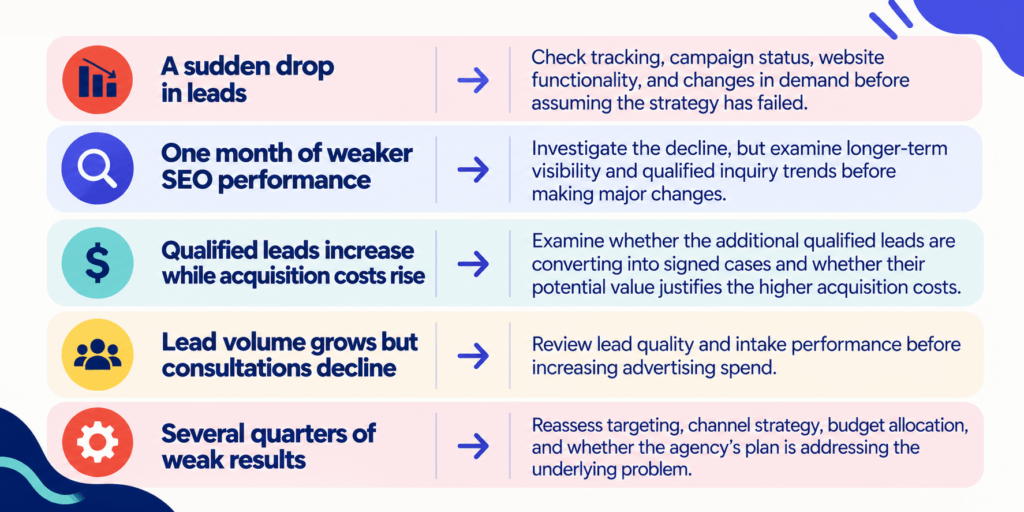
Five common performance scenarios and the factors law firms should evaluate before making marketing changes.
Your marketing agency should be able to explain the reasoning behind its recommendations, whether that means increasing spending, changing campaign priorities, or maintaining the current approach. If additional investment is recommended, your firm should understand what it’s expected to accomplish and how success will be measured. If the recommendation is to give a strategy more time, the agency should explain what additional evidence is needed and when performance will be reassessed. Either way, the discussion should end with an agreed course of action, not another month of watching the numbers.
If your agency cannot explain persistent underperformance, establish a credible improvement plan, or demonstrate how its recommendations support your firm’s goals, it may be time to evaluate whether you need a different marketing partner.
Get a Clearer Picture of Your Law Firm’s Marketing Performance
MeanPug helps law firms connect marketing performance to qualified leads, intake outcomes, signed cases, and business goals. Rather than judging success by isolated reporting periods, we examine performance trends, acquisition costs, and conversion data to help firms understand what’s working, where opportunities may be lost, and when a change in strategy is warranted.
If your reports show plenty of activity but you’re still unsure whether your marketing is moving the business forward, talk to MeanPug. We’ll help you understand what’s working, what needs attention, and what the evidence supports doing next.