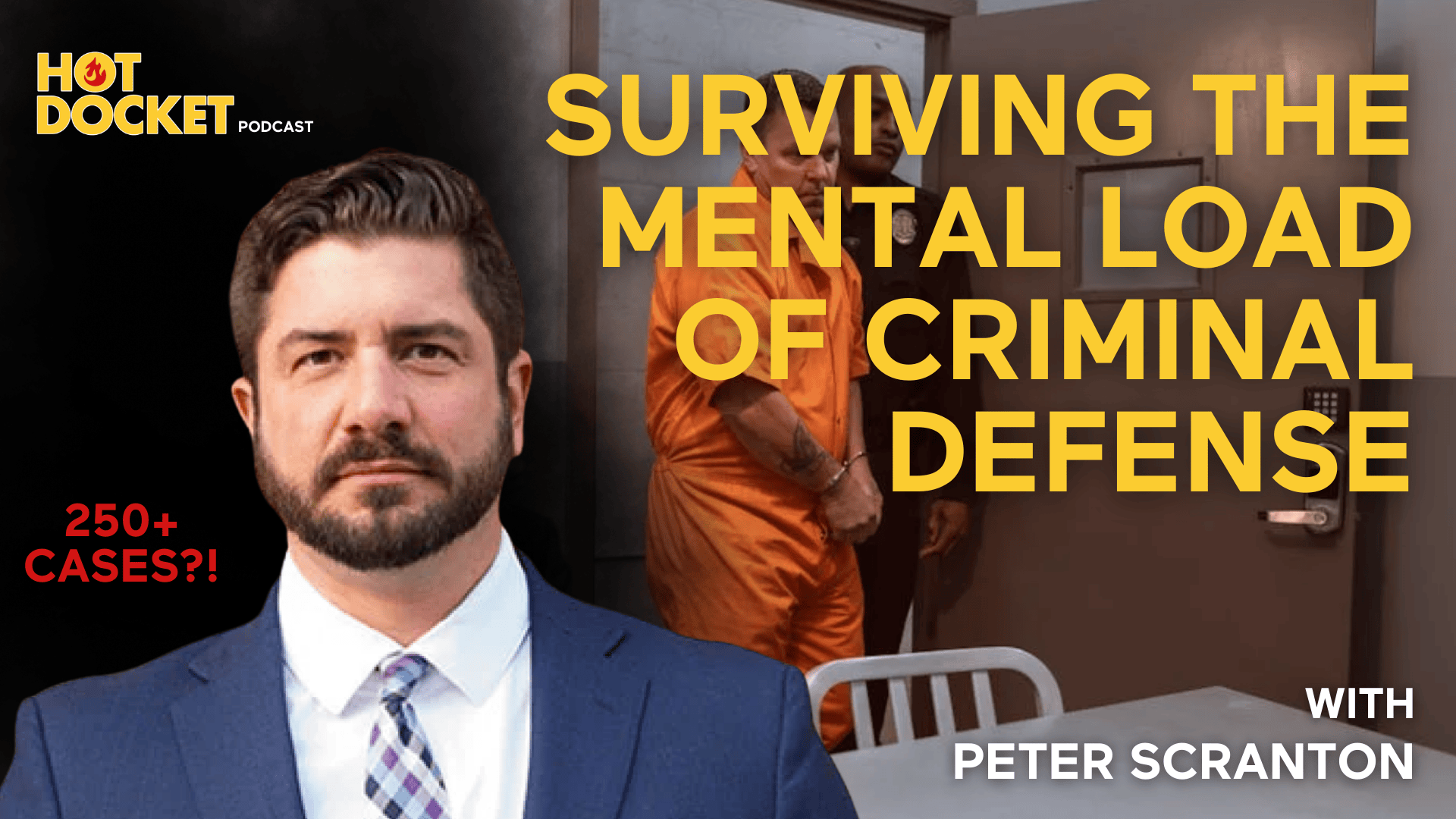
[00:00:00] Peter Scranton: If this individual is already in prison or incarcerated to meet with them, typically you’re going into a room in that facility and that door is locked behind you, and so you are usually one-on-one with that person. Mm-hmm. So the first thing I always tell people is you cannot be afraid. They will know if you’re afraid of them.
[00:00:18] Bobby Steinbach: Welcome to Hot Docket. The show where we talk about winning marketing strategies that have built the most successful law firms. Join us every two weeks for the latest trends and tactics to grow your law firm.
[00:00:29] Andrew Nasrinpay: Welcome to the Hot Docket. Today we’re at NTL in Miami, and we’ve got some special guests. We’ve got Tara Lee from Mean Pug, and we’ve got Peter.
[00:00:43] Peter Scranton: Hi, my name is Peter Scranton. My law firm is Bowen, Scranton and Olson. We do criminal defense. And at our core, all we really wanna do is help people.
[00:00:53] Andrew Nasrinpay: And today we’ve got a ton of interesting things to talk about. Can you give us a quick background on your firm and why you became an attorney?
[00:01:01] Peter Scranton: Yeah. I started out majoring in philosophy and didn’t know really what to do with that, so I went to law school at Ohio State.
[00:01:10] Peter Scranton: My mother was an attorney, so I’m sure that had a lot to do with it. But ultimately after Ohio State, uh, law school, I went to the prosecutor’s office, worked there for a while, and went into criminal defense.
[00:01:23] Andrew Nasrinpay: You might be the only person I’ve heard not call it the Ohio State, the Ohio State, and I, and I appreciate that.
[00:01:31] Peter Scranton: Yeah, I don’t, I don’t particularly like that. Do you know the background of why they do that?
[00:01:34] Andrew Nasrinpay: No. Go go through it quick.
[00:01:36] Peter Scranton: All right. There’s a school, Ohio University in Athens, Ohio, and so they are the Ohio State, so that. OU doesn’t say the Ohio University.
[00:01:45] Andrew Nasrinpay: That’s too funny.
[00:01:46] Peter Scranton: Yeah.
[00:01:48] Andrew Nasrinpay: Alright, so do you wanna tell us a little bit about that background as a prosecutor and kind of how that shaped you today?
[00:01:55] Peter Scranton: Oh, that’s a good question. And honestly, when I was in law school, I wasn’t sure exactly what I was going to do and I could have gone a lot of different ways, but it was just me applying to different jobs. And I got an intern position at the prosecutor’s office in Columbus, Ohio, and I really enjoyed it.
[00:02:13] Peter Scranton: We had an intake division where people that the police didn’t charge. Anyone could come in and talk to us directly. We could decide if we needed more evidence or if we wanted to charge them. We were able to try cases under the supervision of other lawyers. A lot of that is traffic, you know, car accidents or a speeding ticket, but it could be anything else, a theft or domestic violence.
[00:02:37] Peter Scranton: So it’s excellent experience. You know, when you work for the government and the prosecutor’s office, the stakes are actually pretty low. You know, people aren’t paying you directly, so you’re not as nervous about doing it, and you have help. And what I really liked about that group is, you know, it was a large office, a lot of people, and we were all friends.
[00:02:57] Peter Scranton: So every lunch you got to sit around and talk about work cases, just anything. And just having that comradery was great. And from there, you know, I never really changed. I’ve done a pretty general practice landlord, tenant domestic, but I’ve always done criminal. And now my practice is pretty much 95% criminal defense.
[00:03:18] Andrew Nasrinpay: Could you walk us through a couple of like the most common types of cases you handle?
[00:03:23] Peter Scranton: For sure. The most common case we handle is, uh, what in Ohio is called operating a vehicle while impaired. A lot of places call ’em DUIs, but there’s a reason that a private attorney gets those. The big one is somebody that gets an OVI.
[00:03:37] Peter Scranton: Is probably working, probably work worried about their license. Um, you know, they’re, they’re not a hardened criminal. They made a mistake and so they’re willing to pay some money to try to get back on the road, not lose their job, um, avoid points and so they will hire private attorneys. And so that’s a good one.
[00:03:56] Peter Scranton: Uh, they don’t take long. To resolve. They’re usually pretty easy to resolve. There’s a lot of different tricks you can use. So we get a lot of those. Um, probably the other one that’s the most common, unfortunately, is domestic violence. And just because it’s so prevalent.
[00:04:12] Tara Lee: Mm.
[00:04:12] Peter Scranton: And you have a lot of, um, spouses that end up with domestic violence, parents with their children, and it, it just happens a lot.
[00:04:20] Peter Scranton: And again, they’re usually in a position where they can hire someone to help them. Hmm.
[00:04:25] Andrew Nasrinpay: So there’s two trains of thought on, I’ve seen criminal defense firms either specialize and do only DUIs. Mm-hmm. Or only domestic assault, or basically niche down into one or go more general. What is your general feeling on that and like how did you come to where you are today?
[00:04:45] Peter Scranton: Well, I think some firms have decided if they market themselves as being niche, especially with DUIs or something else. That it will help market, and those people will go to them assuming they’re better. I, I want a better result. This person only does this, so I’m gonna go there. Quite honestly with me is, you know, I just have such a soft heart.
[00:05:07] Peter Scranton: If somebody says, Hey Pete, I need you to help me with this, if. If they ask me twice, I’m gonna say yes. And so that’s, you know, if it’s a murder, if it’s a traffic ticket, I’m gonna do it.
[00:05:17] Andrew Nasrinpay: So it’s less even a financial decision. It’s more financial. It’s not, it’s like completely, you want to help people.
[00:05:22] Peter Scranton: Yeah, you can ask anybody in my law firm if, if you ask Pete twice, he’ll say,
[00:05:27] Tara Lee: Yesss.
[00:05:27] Tara Lee: Good tagline.
[00:05:28] Peter Scranton: Yeah, it’s probably not a good thing. But yeah, I’m just, I’m just a softie, you know, especially because. You can look at it from a legal point of view, you know, can I help this person? Is there an avenue to help this person? I really just view it as this person needs help and I’m gonna figure it out.
[00:05:45] Andrew Nasrinpay: So what was the toughest double ask someone’s asked you to help them with?
[00:05:51] Peter Scranton: Oh my gosh. Uh, well, unfortunately for me, or maybe fortunately, I don’t know, we get appointed cases and there will be times where, you know, that’s not a case you would want, you certainly wouldn’t pick it. But the judges need someone to represent that person.
[00:06:08] Peter Scranton: So those are the cases that personally can be really hard. Obviously the hardest thing for me is child rape. I mean, there’s, there’s no part of me that understands that, that agrees with it. But you know, they, they need representation. Someone needs to help them. You know, you don’t have to make sure their case is dismissed.
[00:06:28] Peter Scranton: You’re just mitigating the best you can and making sure you’re going through. That it’s a fair process, but absolutely child rape is the worst.
[00:06:38] Andrew Nasrinpay: For cases that you’re appointed to, what is the average duration that you have to handle that case for?
[00:06:45] Peter Scranton: Man, those typically last longer than a private case, but for an appointed case, the courts try to resolve those cases somewhere within six to nine months, but they can absolutely last three or four years.
[00:06:59] Andrew Nasrinpay: Well, that sounds pretty rough.
[00:07:00] Tara Lee: Yeah.
[00:07:00] Peter Scranton: Yeah, that’s a long time. Absolutely.
[00:07:02] Andrew Nasrinpay: That’s a big ask.
[00:07:03] Peter Scranton: Yeah. I mean, the, the way you feel when you’re, you know, like 25 versus 30 can be very different. So Yeah. It’s a long time to hold onto a case. Mm-hmm.
[00:07:10] Tara Lee: So, Peter, you just talked about some like really heavy cases that you’ve been appointed, um, for other attorneys that, um, are dealing with some really heavy cases.
[00:07:19] Tara Lee: Um, can you talk about how you balance that with your mental health? How do you take care of yourself?
[00:07:25] Peter Scranton: Yeah, I think that’s really important and that’s very difficult for young lawyers in general, and I’ll, I’ll tell you to start just an e an example of how this can go if this individual is already in prison or incarcerated to meet with them.
[00:07:41] Peter Scranton: Typically, you’re going into a room in that facility and that door is locked behind you. And so you are usually one-on-one with that person. Mm-hmm. So the first thing I always tell people is you cannot be afraid. They will know if you’re afraid of them. So even if you’re lying to yourself, you need to, you know, go in there and not be afraid of talking to them.
[00:08:05] Peter Scranton: And then you have to talk about something else. They know if you go in there and you start talking about case law or you highlighted something in a police report. That you’re not really worried about them, you’re just doing your job. And so I always ask ’em about sports. I ask ’em about their family, where they’re from.
[00:08:24] Peter Scranton: 20 or 30 minutes later, I’ll start talking about the case. You want to build a rapport with them. You want them to feel comfortable with you, and you want them to know that you care about them as a person, even if you don’t like their actions or agree with any of that. I always remind myself. That’s someone’s daughter, that’s someone’s son.
[00:08:42] Peter Scranton: Maybe they have their own children, and those people care about them and want you to do a good job. So, I mean, I think that’s a good trick for starting in terms of compartmentalizing, how you deal with that. You just gotta set it down. You, you just cannot take it home with you. Unfortunately, it is. It’s a job.
[00:09:04] Peter Scranton: And so you do your job, you do it the best that you can, and then you stop. Uh, I always tell people that like being in college or being in school, you could study forever. I mean, you could study 24 hours a day and maybe it’s not enough. You have to force yourself to stop. And the same with being an attorney.
[00:09:21] Peter Scranton: You could look at the case all day, but at sometime, at some point you just have to decide, you know, I’m not gonna deal with this anymore. I did my best, and you let it go.
[00:09:32] Andrew Nasrinpay: How many cases do you think. Uh, a defense attorney can take at any given time, specifically for criminal defense.
[00:09:40] Peter Scranton: I mean, I prob
[00:09:40] Andrew Nasrinpay: and do a good job representing the clients.
[00:09:43] Peter Scranton: Oh, man, that’s a good question. We talk about this a lot at our firm ’cause we represent a lot of people. I probably have about 250 clients right now, which seems like a lot. I mean, honestly, to do the absolute best you can for somebody. That’s probably somebody that’s retired and decides just to take a case at a time.
[00:10:03] Peter Scranton: Mm. ’cause you can dedicate all of your time to it. But there’s two sides to that. If you have someone that’s not hand handling a lot of cases, it’s probably ’cause not a lot of people want them. If you have somebody that’s really, really busy, it’s probably ’cause they’re really good. So you have both sides of that.
[00:10:20] Peter Scranton: And so, you know, again, man, that’s a, that’s a tough question. I would say. Absolute best case scenario would be one case in the morning, one case in the afternoon, probably no more than 10 cases a week, but I think most defense attorneys handle a lot more than that.
[00:10:38] Andrew Nasrinpay: And the biggest problem with that too is the better you are and the more cases that are coming in,
[00:10:42] Peter Scranton: mm-hmm.
[00:10:43] Andrew Nasrinpay: The more process you have to build. And when you build process, it makes it less of like a. You know, human touch and all the elements that you really care about, that you were just talking about. So it’s, it’s a really tough balancing act.
[00:10:58] Peter Scranton: It, it is. And it’s really hard to give that personal element to people, but you have to commit yourself to it.
[00:11:05] Peter Scranton: And so, just as an example, at my law firm, which I don’t think is very common, everyone always has my cell phone number, and that way I can text. So if I’m in the courtroom, if it’s late at night or something, you know, I don’t have to answer the phone. But I’m communicating with them. So, you know, that’s really important.
[00:11:22] Peter Scranton: A big complaint you’ll have from a lot of clients is, I tried to get in touch with this person and they just won’t, they won’t answer, they won’t call me back. And you know, we just try to stay as communicative as possible with these people.
[00:11:34] Andrew Nasrinpay: I think regardless of case type, that is probably the number one complaint.
[00:11:38] Peter Scranton: Yeah.
[00:11:38] Andrew Nasrinpay: Clients have with attorneys Absolutely. Is, is poor communication.
[00:11:41] Peter Scranton: Yeah. You, you call a lawyer’s office, the secretary answers the phone and they’ll say. Uh, yeah. Is, is he here? And you know, they wait like five minutes, you know, they’re going back to ask, you wanna take a phone call? Oh no, they’re out.
[00:11:55] Peter Scranton: You know? Right. Yeah. I don’t know what it is with lawyers, but they, they don’t seem very interested in spending a lot of time with their clients and clients. They just want to talk. I mean, a lot of it is venting, obviously, but they, they want that relationship.
[00:12:10] Andrew Nasrinpay: So how, how do you currently, um, do marketing for your firm where your case is coming from?
[00:12:17] Andrew Nasrinpay: Uh, what percentage are referrals do you typically find the highest quality cases are coming from referrals? The internet. Can you tell us?
[00:12:25] Peter Scranton: Yeah. I mean, absolutely 100%. The best cases you get are referrals, and I think that’s because, let’s say you called me and you said, Pete, I want you to handle this, but it’s a divorce and I don’t wanna do it.
[00:12:38] Peter Scranton: I would send you to one person. I would say, hire this person. You’re gonna do it. And if somebody like that sends them directly to me, they’re gonna hire me because there’s a trust factor. Or if their best friend got in trouble before and you help them, they’re gonna hire you.
[00:12:55] Tara Lee: How, yeah. How have you built out those referral relationships, like your network?
[00:13:00] Tara Lee: Um,
[00:13:01] Peter Scranton: well for me it’s easy because, you know, I have a lot of friends that are attorneys in, in my area and, you know, all over, but mostly in Columbus. And if they’re good to me and they send me clients, I’ll send them back. If you know they’re saying nice things about us, then I’ll send them back and yeah, you just really, it’s a group of friends more than anything.
[00:13:22] Peter Scranton: Sure. Yeah.
[00:13:22] Tara Lee: Okay.
[00:13:23] Andrew Nasrinpay: Are there any, um, like crazy cases or any cases that you’re particularly proud of in general that, that you’d wanna give the listeners? Um, you know, something to hear
[00:13:35] Peter Scranton: so many. I mean, I, I, there are so many cases I, I’ll, uh, I’ll start with this because sometimes you forget, but, uh, last week I got a text message from a client and it wasn’t a super complicated case.
[00:13:49] Peter Scranton: But he just said, Pete, never forget that you change lives with your work. And he said, you help me now, I’m gonna get a better job. You know, the long-term effects of really caring about that person, and it doesn’t have to be a big case to do that. Uh, for commercial drivers, not having points is a big deal for them.
[00:14:09] Peter Scranton: So there are a lot of ways that you can really affect people in a positive way. Those cases you feel really good about, man, if you, if you have somebody you like that comes in and you help them. You feel really good. You do not feel good. If there’s somebody you don’t like and you win, you, you don’t leave that case feeling good.
[00:14:29] Peter Scranton: You, you feel resolved and you feel like you’ve done your job, but you certainly don’t feel like you, uh, you’re not happy about it. In terms of absolute craziest cases, I mean, there’s so many. Um, I was talking to someone last night and as I thought about it, I thought about this case and it’s really interesting in a lot of levels.
[00:14:49] Peter Scranton: Uh, it’s probably not PG for children, but we had a, a circumstance where there was a, a really violent rape in Columbus and it appeared as though someone had taken a rock to this woman’s head. So she was unconscious, bleeding on the ground. It shattered her skull. They didn’t think she would survive. And we represented the individual who was passed out right next to her.
[00:15:16] Peter Scranton: So obviously when the police came, uh, it made sense to arrest that individual. Ultimately, they indicted him. He sat in jail for at least two and a half years until we could have his jury trial. And then at the jury trial, she takes the stand and they say, Hey, is the individual that raped you here? Which is just a standard question and that individual sitting next to me.
[00:15:40] Peter Scranton: At the table, they’re easy to point out. And she said no. So we had spent two and a half years with this person in jail and they had, as far as I knew, never asked her to actually identify the defendant. So either she was, you know, so violently hurt. She didn’t remember or really wasn’t him. He was adamant it wasn’t him.
[00:16:02] Peter Scranton: Um, but yeah, you know, things like that, that’s stranger than fiction. You can’t really. Uh, you would think that would never happen. And it does. It happens a lot.
[00:16:10] Andrew Nasrinpay: Well, that’s, that’s wild.
[00:16:12] Peter Scranton: Mm-hmm. Yeah.
[00:16:12] Producer Rita Richa: When, when cases like that happen, like what, what is the next, what’s the next step? It, does it just stay at, well, do we not have a case anymore?
[00:16:22] Producer Rita Richa: Like what’s the follow up process?
[00:16:24] Peter Scranton: Yeah, so that was at the jury trial, and so ultimately what happened in that case is you file a motion for rule 29 or an oral motion. When the prosecutor is done presenting their evidence, and the judge can make a direct finding, and in this case she did, you know, she ruled 29.
[00:16:43] Peter Scranton: The charges. That individual is shackled. Um, typically in handcuffs. Not always, but they go, they unshackle them, and that individual walks out of the courtroom with you and, uh, it’s as crazy as that.
[00:16:59] Andrew Nasrinpay: Is there anywhere that, um, folks can find you? Do you have social media or website or anything you’d wanna leave so people could get in touch with you?
[00:17:07] Peter Scranton: Yeah, A lot of people find us on Google. Our law firm name is Bowen Scran and Olson. We have a Facebook page and then obviously our website, which is bso defense.com.
[00:17:21] Andrew Nasrinpay: All right. Well it was a pleasure having you here today. Thank you,
[00:17:23] Tara Lee: Peter.
[00:17:23] Peter Scranton: You’re welcome.
[00:17:24] Andrew Nasrinpay: Thank you for joining us on the Hot Docket. Uh, we really appreciated it and we’ve had a very interesting conversation.
[00:17:30] Peter Scranton: It was a pleasure being here. Thank you for inviting me.
[00:17:32] Tara Lee: It’s great meeting you, Peter. Well, enjoy the rest of your conference.
[00:17:35] Peter Scranton: Thank you.
[00:17:36] Bobby Steinbach: We hope you’ve enjoyed this episode of Hot Docket. We’re your hosts, Bobby and Andrew, founders of Meme Pug, the marketing agency for ambitious law firms.
[00:17:44] Andrew Nasrinpay: Have questions about marketing or anything we covered today?
[00:17:47] Andrew Nasrinpay: Email us at bark@memepug.com. Be sure to subscribe to learn more. Until next time.